


Table of Contents
- Why Tensile Structures in 2026?
- 30-50% Lower Construction Cost
- 5x Faster Installation
- 90-95% Lighter Than Conventional Roofs
- Natural Daylight & Energy Savings
- Engineered for Indian Weather
- 15-30 Year Lifespan
- Column-Free Large Spans
- UV Protection & Heat Reduction
- Minimal Maintenance
- Versatile Design Options
- Environmentally Sustainable
- Relocatable & Expandable
- Fire Resistant
- Superior Acoustic Performance
- Enhances Property Value
- Tensile vs Conventional Comparison
- Frequently Asked Questions
The Indian construction industry is undergoing a fundamental shift. In 2026, architects, builders, and property owners are moving away from heavy concrete and metal roofing toward a smarter, faster, and more cost-effective alternative — tensile structures. But what exactly makes tensile structures so compelling? Is it just the visual appeal, or are there tangible, measurable benefits?
At Tensile Craft Pvt. Ltd., having manufactured and installed over 500+ tensile structures across India — from car parking shades in Delhi to dome structures for stadiums — we have first-hand data on how tensile structures outperform conventional construction across every metric that matters.
In this article, we present the 15 proven benefits of tensile structures with real numbers, real comparisons, and real Indian project references. If you are evaluating whether to invest in a tensile structure, this guide will give you the complete picture.
Quick Summary: Tensile structures offer 30-50% cost savings, 5x faster installation, 90-95% weight reduction, natural daylight transmission, 15-30 year lifespan, and full IS-compliant engineering — making them the most practical construction solution for shading and roofing in India in 2026.
Why Tensile Structures in 2026?
The Indian tensile structure market has grown at a 12.5% CAGR over the past five years, driven by rising construction costs, faster project timelines, and increasing awareness of sustainable building practices. In 2026, the advantages are more relevant than ever:
- Steel and cement prices have increased 40-60% since 2020, making conventional roofing significantly more expensive
- Project deadlines are tighter — developers need structures that install in days, not months
- Green building norms (IGBC, GRIHA) now reward lightweight, energy-efficient, and recyclable construction
- Advanced fabrication technology (CNC cutting, 3D form-finding) has made tensile structures more precise and reliable
If you are new to tensile structures, start with our complete guide: What is Tensile Structure? for the fundamentals. Below, we dive straight into the benefits.
1. 30-50% Lower Construction Cost
This is the number one reason clients choose tensile structures — direct cost savings. Here is a realistic comparison for a 2,000 sq.ft. car parking structure in Delhi NCR (2026 rates):
| Cost Component | Concrete Shed | Tensile Structure | Savings |
|---|---|---|---|
| Civil Foundation | ₹1.5 - 2.0 lakhs | ₹0.4 - 0.6 lakhs | 65-70% |
| Structural Framework | ₹1.0 - 1.5 lakhs | ₹0.5 - 0.8 lakhs | 45-50% |
| Roofing Material | ₹0.5 - 0.8 lakhs | ₹0.4 - 0.7 lakhs | 15-20% |
| Labour & Installation | ₹0.8 - 1.2 lakhs | ₹0.2 - 0.4 lakhs | 65-70% |
| Total Project Cost | ₹3.8 - 5.5 lakhs | ₹1.5 - 2.5 lakhs | 45-55% |
| Cost per sq.ft. | ₹190 - 275 | ₹75 - 125 | 50-55% |
The savings are even greater for larger spans. A tensile roof structure spanning 50+ meters costs a fraction of what a steel truss + metal deck roof would cost, because tensile structures eliminate the need for intermediate columns and heavy purlins.
For detailed per sq.ft. pricing across all structure types, see our Tensile Structure Cost in India 2026 guide.
2. 5x Faster Installation
Time is money in construction. Here is a realistic timeline comparison:
| Activity | Concrete Shed | Tensile Structure |
|---|---|---|
| Design & Engineering | 2-3 weeks | 3-5 days |
| Foundation Work | 3-4 weeks | 3-5 days |
| Structural Fabrication | 4-6 weeks | 1-2 weeks |
| Roofing Installation | 2-3 weeks | 2-4 days |
| Curing & Finishing | 2-3 weeks | Not required |
| Total Timeline | 13-19 weeks | 2-4 weeks |
A tensile car parking structure for 50 cars is typically installed in 7-15 working days from the date of foundation readiness. For commercial projects like walkway coverings at IT parks or hospitals, this speed means zero disruption to ongoing operations.
3. 90-95% Lighter Than Conventional Roofs
The weight advantage of tensile structures is not just a technical detail — it has cascading benefits across the entire project:
| Roofing System | Weight per sq.m. | Foundation Requirement |
|---|---|---|
| RCC Slab (125mm) | 300 kg | Heavy, deep footings |
| Metal Deck + Insulation | 25-35 kg | Medium footings |
| Polycarbonate Sheet | 3-5 kg | Light footings |
| Tensile Membrane | 1-5 kg | Minimal footings |
Because the tensile fabric weighs just 1-5 kg per square meter, the supporting steel structure is significantly lighter, and the foundation can be shallower and smaller. This is particularly valuable for:
- Rooftop installations where structural capacity is limited
- Lightweight structures for temporary events and exhibitions
- Retrofit projects where existing foundations cannot be modified
- Seismic zones where lighter structures perform better
4. Natural Daylight & Energy Savings
Tensile fabric membranes are translucent — they transmit natural daylight while diffusing it evenly, eliminating harsh shadows and glare. This has direct financial impact:
- 8-15% light transmission (PVC fabric) — reduces daytime lighting electricity by 30-40%
- 10-25% light transmission (PTFE fabric) — ideal for spaces requiring brighter interiors
- No artificial skylights needed — the entire roof acts as a light source
For a tensile roof structure covering a 10,000 sq.ft. warehouse or factory, the annual lighting electricity saving can be ₹1.5-3.0 lakhs, depending on local tariff rates. Over a 20-year structure life, that is ₹30-60 lakhs in pure energy savings.
Want to Calculate Your Savings?
Share your project details and we will send a cost comparison — tensile vs conventional — within 24 hours.
Get Free Cost Comparison5. Engineered for Indian Weather
India presents some of the toughest weather challenges for any building system — extreme heat, heavy monsoons, high wind speeds, and coastal salt air. Tensile structures are specifically engineered for all of these:
Monsoon Performance
Tensile membranes are designed with minimum 15-25 degree slopes, ensuring rainwater runs off rapidly without ponding. The pre-tension in the fabric prevents sagging even under sustained heavy rainfall of 100-200 mm/hour. This is a significant advantage over flat or low-slope concrete roofs that often suffer from water accumulation and leakage.
Wind Resistance
All structures designed by Tensile Craft comply with IS 875 Part 3 for wind loads. Depending on the location (wind zone as per IS 875), our structures are designed for wind speeds of 120-150 km/h. The fabric's flexibility allows it to absorb wind energy without damage, unlike rigid roofs that can fail catastrophically under wind uplift.
Heat Performance
Under the Indian summer sun (surface temperatures can exceed 65°C on conventional roofs), tensile fabrics perform significantly better. The fabric reflects a portion of solar radiation, and the curved shape promotes natural convection — hot air rises and escapes, keeping the shaded area cooler. Temperature reduction under a tensile car parking shade is typically 10-15°C compared to open sun.
6. 15-30 Year Lifespan
Tensile structures are not temporary solutions — they are engineered for long-term performance:
- PVC-coated polyester (with PVDF top coat): 15-20 years — the workhorse fabric for Indian projects. Used in car parking, walkways, and awnings.
- PTFE-coated fiberglass: 25-30 years — the premium choice with self-cleaning properties. Used in airports, stadiums, and landmark architectural projects.
- Galvanized steel framework: 40+ years — hot-dip galvanized as per IS 2629/IS 2633, with polyester powder coating for additional protection.
The key insight: when the fabric eventually reaches end-of-life, it can be replaced without changing the steel structure. The replacement cost is typically 25-35% of the original project cost, effectively giving you a second structure life at a fraction of the price.
7. Column-Free Large Spans
This is an advantage that no conventional roofing system can match at reasonable cost. Tensile structures can span 50-100+ meters without a single intermediate column. For context:
- Steel truss roofing: practical span limit is 25-30 meters without intermediate columns
- RCC framing: practical span limit is 12-15 meters
- Tensile membrane: spans of 50-100 meters are routine; world record exceeds 200 meters
This makes tensile structures ideal for dome structures, stadiums, exhibition halls, and large roof structures where column-free space is essential for functionality and aesthetics.
8. UV Protection & Heat Reduction
In a country where UV index regularly exceeds 8-10 (very high to extreme), protection from solar radiation is a genuine health and safety requirement, not a luxury. Tensile fabrics provide:
- UPF 50+ UV protection — blocks 98%+ of harmful UV-A and UV-B radiation
- Solar heat gain reduction of 70-80% compared to open sun exposure
- Temperature reduction of 10-15°C in shaded areas
This is why tensile car parking structures are preferred by residential societies — they protect vehicle paint, interiors, and dashboards from UV degradation. For swimming pool covers, UV protection prevents algae growth and chemical degradation of pool water.
9. Minimal Maintenance
Compare the annual maintenance requirements:
| Maintenance Task | Concrete Roof | Metal Roof | Tensile Fabric |
|---|---|---|---|
| Waterproofing | Every 3-5 years | Every 2-3 years | Not required |
| Painting / Coating | Every 5-7 years | Every 3-5 years | Not required (fabric) |
| Cleaning | Occasional | 2-3 times/year | 1-2 times/year (rain does most of it) |
| Crack / Leak Repair | Frequent | Occasional | Rare |
| Annual Cost (2,000 sq.ft.) | ₹15,000 - 25,000 | ₹8,000 - 15,000 | ₹2,000 - 5,000 |
PTFE fabrics are self-cleaning — their non-stick surface (similar to Teflon) means dirt washes off with rain. PVC fabrics require periodic washing but are far easier to maintain than any conventional roofing system. For detailed maintenance guidance, read our 20 Expert Maintenance Tips.
10. Versatile Design Options
No other roofing system offers the design flexibility of tensile structures. The fabric can be shaped into virtually any three-dimensional form:
- Conical/umbrella shapes for individual shade points
- Saddle/hypar shapes for dramatic entrance canopies
- Barrel vault shapes for linear walkway coverings
- Dome shapes for iconic landmark structures
- Free-form organic shapes for architectural statements
Fabrics are available in a wide range of colours (PVC) or classic white (PTFE), can be printed with logos and graphics, and can be backlit for nighttime effect. This versatility makes tensile structures the preferred choice for gazebos, resort installations, and branded commercial environments.
11. Environmentally Sustainable
Sustainability is no longer optional — it is a requirement for IGBC and GRIHA certified projects. Tensile structures score highly on every green metric:
- 70-80% less material consumed compared to conventional construction
- 100% recyclable — both PVC and PTFE fabrics can be recycled at end of life; steel framework is fully recyclable
- Lower embodied energy — manufacturing a fabric membrane requires significantly less energy than producing cement or steel sheets
- Reduced operational energy — natural daylight and heat reflection lower electricity consumption
- Smaller carbon footprint — less material + less transport + less installation energy
- No wet construction — no concrete mixing, curing, or water wastage on site
12. Relocatable & Expandable
Unlike concrete, which is permanent, tensile structures can be dismantled and re-erected at a different location. This is valuable for:
- Construction sites where the shade structure needs to move as work progresses
- Event venues and temporary installations
- Leasehold properties where you cannot make permanent modifications
- Businesses that may relocate or expand in the future
Additionally, tensile structures are expandable — if you initially install a car parking shade for 20 cars and later need capacity for 40, additional bays can be added by extending the steel framework and fabric without disrupting the existing structure.
13. Fire Resistant
Fire safety is critical for any public structure. Tensile fabrics meet stringent fire ratings:
- PVC fabric: B1 rated (self-extinguishing) — does not support flame spread, self-extinguishes when the ignition source is removed
- PTFE fabric: A rated (non-combustible) — will not burn, meets the most stringent fire codes worldwide
Both fabrics meet IS 6746 testing standards and are accepted by fire departments across India for use in public buildings, commercial spaces, and entrance canopies where fire safety compliance is mandatory.
14. Superior Acoustic Performance
An often-overlooked benefit: tensile membranes absorb sound rather than reflecting it. This makes them particularly effective for:
- Auditorium and multipurpose hall roofing — reduces echo and reverberation time
- Industrial facilities near residential areas — the fabric absorbs machinery noise
- Rain noise — the curved shape and fabric flexibility significantly reduce the drumming noise that metal roofs create during rainfall
Sound absorption coefficients for PVC membrane range from 0.10-0.25 depending on frequency, which is comparable to dedicated acoustic ceiling panels — but you get this performance as a built-in property of the roofing material, not as an additional layer.
15. Enhances Property Value
A well-designed tensile structure is not just functional — it is an architectural asset that enhances the perceived value of the property:
- Commercial buildings with dramatic tensile entrance canopies command higher rental rates
- Residential societies with tensile car parking and gazebo structures have higher resale values
- Hotels and resorts with tensile architecture create Instagram-worthy spaces that drive bookings
- Industrial facilities with modern tensile roofing attract better tenants
The aesthetic impact of a tensile membrane structure is disproportionate to its cost — it creates a premium, contemporary image that conventional roofing simply cannot achieve.
See These Benefits in Action
Visit our gallery of 500+ completed projects across India — or tell us your requirement and we will share relevant case studies.
View Our GalleryTensile vs Conventional: Final Comparison
| Parameter | Tensile Structure | Conventional (Concrete/Metal) |
|---|---|---|
| Cost per sq.ft. | ₹75 - 450 | ₹190 - 800+ |
| Installation Time | 7-21 days | 2-6 months |
| Weight | 1-5 kg/sq.m | 25-300 kg/sq.m |
| Max Span (no columns) | 100+ meters | 25-30 meters |
| Lifespan | 15-30 years (fabric) | 30-50 years (structure) |
| Natural Daylight | Yes (8-25%) | No (without skylights) |
| Annual Maintenance | ₹2-5 per sq.ft. | ₹8-25 per sq.ft. |
| Recyclable | Yes (100%) | Partially |
| Relocatable | Yes | No |
| Design Flexibility | Unlimited curved forms | Limited to flat/sloped planes |
Frequently Asked Questions
What are the main benefits of tensile structures?
The main benefits include 30-50% lower cost than conventional construction, 5x faster installation, 90-95% lighter weight, natural daylight transmission, UV protection, low maintenance, column-free spans up to 100 meters, and full recyclability of materials.
Is tensile structure cheaper than concrete?
Yes. A tensile car parking structure costs ₹250-450 per sq.ft. compared to ₹500-800+ per sq.ft. for concrete. For a 2,000 sq.ft. car park, tensile costs ₹1.5-2.5 lakhs vs ₹3-5 lakhs for concrete, plus installation completes in 7-15 days instead of 2-3 months.
How long does a tensile structure last?
PVC tensile fabric lasts 15-20 years and PTFE fabric lasts 25-30 years. The galvanized steel framework lasts 40+ years. With proper maintenance, total structure life can exceed 30 years. Fabric can be replaced independently without changing the steel structure.
Are tensile structures safe in Indian weather?
Yes. They are engineered as per IS 875 Part 3 for wind loads up to 120-150 km/h, designed for monsoon rainfall with 15-25 degree slopes for water runoff, and tested for temperatures from -10°C to +70°C. They also provide UPF 50+ UV protection.
Can tensile structures reduce electricity costs?
Yes. Translucent fabric membranes transmit 8-25% natural daylight, reducing artificial lighting needs by up to 40% during daytime. The fabric also reflects significant solar heat, reducing air conditioning load by 15-25% compared to metal roofing.
Are tensile structures environmentally friendly?
Yes. They use 70-80% less material than conventional construction, fabrics are 100% recyclable, require less energy for installation, reduce operational energy through natural daylight, and have a smaller carbon footprint throughout their lifecycle.
Related Articles
Continue reading more about tensile structures
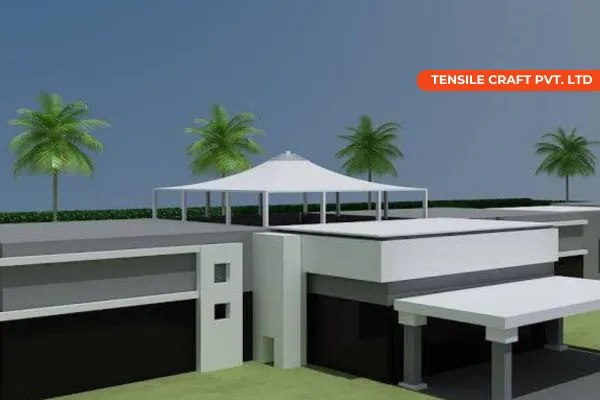
What is Tensile Structure? Complete Guide
Understand what tensile structures are, how they work, components, types, and why they matter in India.
Basics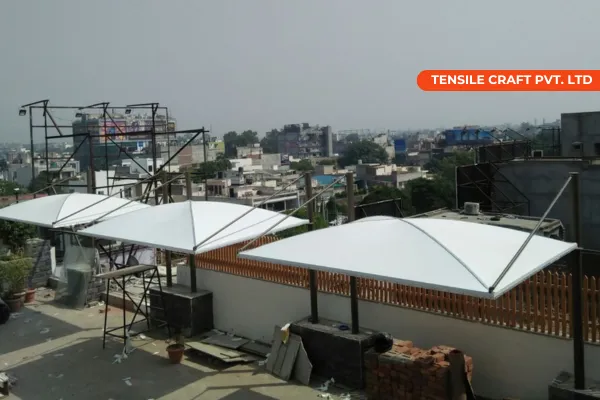
Tensile Structure Cost in India 2026
Detailed per sq.ft. pricing for all types — cost factors, comparison tables, and money-saving tips.
Cost Guide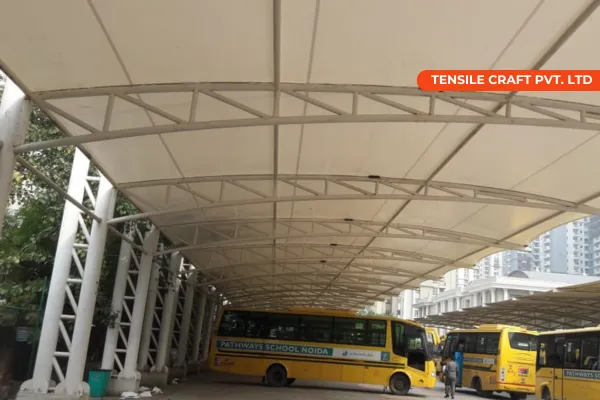
20 Expert Maintenance Tips
Proven strategies to extend your tensile structure's life by 15+ years in Indian climate conditions.
Maintenance