


Table of Contents
- Quick Rate Card: All Structure Types
- What Makes Up the Total Cost?
- Fabric Cost: PVC vs PTFE Impact
- Steel Framework Cost
- Foundation Cost
- Installation & Labour Cost
- City-Wise Cost Variations Across India
- Tensile Car Parking: Detailed Pricing
- Tensile vs Concrete: Cost Comparison
- 8 Ways to Reduce Your Cost
- Hidden Costs to Watch For
- Annual Maintenance Cost
- Frequently Asked Questions
The first question every client asks us at Tensile Craft is: "Kitna lagega?" (How much will it cost?). And it is the right question — but the answer depends on several variables that most online articles gloss over with vague ranges.
This guide is different. Based on our actual invoices for 500+ installations across India in 2025-2026, we provide exact per sq.ft. rates for every type of tensile structure, a transparent cost breakdown, city-wise rate variations, and actionable strategies to reduce your project cost without compromising quality.
Quick Answer: Tensile structure cost in India ranges from ₹75 to ₹900 per sq.ft. (all-inclusive). A standard tensile car parking for one car costs ₹50,000-90,000. A 10-car structure costs ₹3.5-7.5 lakhs. Premium membrane roofing costs ₹350-700 per sq.ft. These are 2026 rates including design, material, fabrication, and installation.
Quick Rate Card: All Structure Types
These are all-inclusive rates (design + material + fabrication + installation) based on Delhi NCR 2026 pricing for PVC fabric with PVDF coating:
| Structure Type | Cost per sq.ft. | Typical Size | Total Cost Range |
|---|---|---|---|
| Tensile Umbrella | ₹75 - ₹150 | 200-250 sq.ft. | ₹50,000 - ₹90,000 |
| Tensile Gazebo | ₹120 - ₹250 | 150-400 sq.ft. | ₹60,000 - ₹2,00,000 |
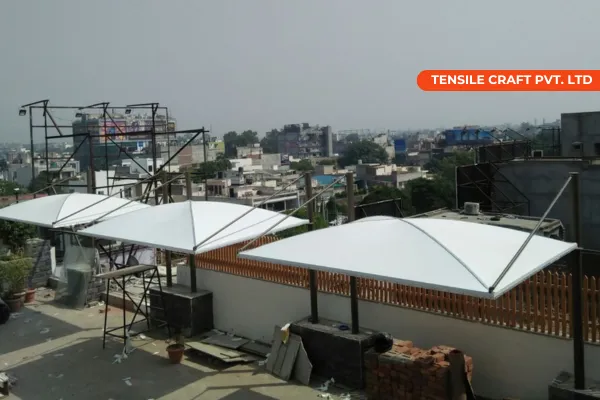
| Tensile Car Parking (Single) | ₹250 - ₹360 | 200-250 sq.ft. | ₹50,000 - ₹90,000 |
| Tensile Car Parking (Multi) | ₹175 - ₹300 | 1,000-10,000 sq.ft. | ₹1.75L - ₹30L |
| Car Parking Structure (Premium) | ₹300 - ₹450 | 5,000-20,000 sq.ft. | ₹15L - ₹90L |
| Walkway Covering | ₹200 - ₹350 | 500-5,000 sq.ft. | ₹1L - ₹17.5L |
| Entrance Canopy | ₹250 - ₹450 | 300-2,000 sq.ft. | ₹75,000 - ₹9L |
| Awning / Canopy | ₹150 - ₹300 | 100-500 sq.ft. | ₹15,000 - ₹1.5L |
| Swimming Pool Cover | ₹250 - ₹450 | 500-3,000 sq.ft. | ₹1.25L - ₹13.5L |
| Tensile Roof Structure | ₹350 - ₹700 | 2,000-50,000 sq.ft. | ₹7L - ₹3.5Cr |
| Tensile Membrane Structure | ₹400 - ₹800 | 5,000-50,000 sq.ft. | ₹20L - ₹4Cr |
| Tensile Dome Structure | ₹500 - ₹900 | 5,000-1,00,000 sq.ft. | ₹25L - ₹9Cr |
| Polycarbonate Structure | ₹200 - ₹400 | 500-10,000 sq.ft. | ₹1L - ₹40L |
| Lightweight / Temporary | ₹75 - ₹200 | 200-5,000 sq.ft. | ₹15,000 - ₹10L |
Why does per sq.ft. cost decrease with size? Fixed costs (design, engineering, mobilization, fabrication setup) remain roughly constant regardless of project size. A single-car umbrella has the same ₹15,000-25,000 design and mobilization overhead as a 50-car parking structure. Spread over 250 sq.ft., that overhead is ₹60-100/sq.ft. Spread over 10,000 sq.ft., it drops to ₹1.5-2.5/sq.ft. This is the single biggest reason why larger projects get better per sq.ft. rates.
What Makes Up the Total Cost?
Every rupee you spend on a tensile structure falls into one of five categories. Here is the typical split for a mid-size project:
| Cost Component | % of Total | For ₹5L Project | Details |
|---|---|---|---|
| Steel Framework | 30-35% | ₹1.5L - ₹1.75L | MS pipes/tubes, galvanizing, powder coating, base plates |
| Fabric Membrane | 20-30% | ₹1.0L - ₹1.5L | PVC+PVDF or PTFE fabric, CNC cutting, HF welding |
| Foundation | 10-15% | ₹50,000 - ₹75,000 | Excavation, concrete, anchor bolts, curing |
| Design & Engineering | 5-10% | ₹25,000 - ₹50,000 | 3D modelling, structural analysis, fabrication drawings |
| Installation & Logistics | 15-25% | ₹75,000 - ₹1.25L | Transport, erection, tensioning, site cleanup |
Fabric Cost: PVC vs PTFE Impact
The fabric choice has the biggest variable impact on your total cost. Here is what it means in rupees:
| Fabric | Cost per sq.m. | Cost per sq.ft. | For 2,000 sq.ft. project | Impact on total cost |
|---|---|---|---|---|
| PVC + Acrylic (basic) | ₹300-500 | ₹28-46 | ₹52,000 - ₹86,000 | Baseline (not recommended for outdoor) |
| PVC + PVDF (recommended) | ₹380-650 | ₹35-60 | ₹65,000 - ₹1,12,000 | Standard specification |
| PTFE (premium) | ₹800-1,200 | ₹74-111 | ₹1,38,000 - ₹2,07,000 | +₹73,000 - ₹95,000 over PVDF |
For a detailed technical comparison of these fabrics, read our PTFE vs PVC Tensile Fabric guide.
Steel Framework Cost
Steel is the largest single cost component. Rates vary based on specification:
| Steel Specification | Rate per kg | When Used |
|---|---|---|
| MS pipes, galvanized + powder coat | ₹85-110/kg | Standard for car parking, walkways, canopies (90% of projects) |
| MS square tubes, galvanized + powder coat | ₹90-120/kg | Architectural structures requiring box sections |
| MS with duplex coating | ₹110-140/kg | Coastal areas (within 5km of sea) — galvanizing + epoxy + PU |
| Stainless steel 304/316 | ₹250-350/kg | Rarely used — only for highly corrosive chemical environments |
A typical 2,000 sq.ft. car parking structure uses approximately 800-1,200 kg of steel, translating to ₹70,000-1,30,000 for the steel component alone.
Foundation Cost
Foundation is the most underestimated cost item. Here are realistic rates:
| Foundation Type | Size per footing | Cost per footing | Application |
|---|---|---|---|
| Isolated pad footing | 1.0x1.0x0.6m | ₹3,500-5,000 | Standard car parking columns |
| Isolated pad footing (large) | 1.5x1.5x0.75m | ₹6,000-9,000 | Tall structures, high wind zones |
| Extended footing on rock | Variable | ₹8,000-15,000 | Rocky terrain where excavation is difficult |
| Chemical anchor (no excavation) | N/A | ₹2,000-4,000 | Retrofit on existing concrete slabs |
A 10-car parking row (4-5 columns) typically needs 4-5 footings, costing ₹15,000-25,000 total for the foundation component. This is a fraction of the concrete shed foundation cost for the same coverage.
Installation & Labour Cost
Installation cost depends on project complexity, duration, and location:
- Standard installation (Delhi NCR): ₹25,000-40,000 per day for a 4-6 person crew including supervisor
- Outstation installation: ₹30,000-50,000 per day + transport and accommodation for the crew
- Crane requirement: ₹15,000-25,000 per day if a crane is needed (usually for structures above 5m height or heavy steel sections)
- Overtime/weekend work: 1.5x standard daily rate
A typical 2,000 sq.ft. car parking structure requires 3-5 installation days, totalling ₹75,000-2,00,000 for installation including transport and mobilization.
City-Wise Cost Variations Across India
Tensile structure rates vary across Indian cities based on local steel prices, labour costs, and competition level:
| City / Region | Rate Variation | Reason |
|---|---|---|
| Delhi NCR | Baseline (₹1.00x) | Most competitive market, maximum manufacturers |
| Mumbai / Pune | ₹1.05-1.10x | Higher labour, transport; coastal duplex coating adds cost |
| Bangalore / Hyderabad | ₹1.05-1.10x | Good competition but slightly higher logistics |
| Chennai | ₹1.08-1.12x | Coastal — most projects need duplex coating |
| Jaipur / Lucknow / Chandigarh | ₹1.05-1.10x | Tier-2 cities, fewer local manufacturers |
| Kolkata / Bhubaneswar | ₹1.08-1.15x | Higher humidity requires better coating |
| Ahmedabad / Surat / Rajkot | ₹0.95-1.05x | Gujarat has strong steel fabrication ecosystem, rates can be lower |
| North East India | ₹1.15-1.25x | Significant logistics surcharge, limited local capability |
| Kerala / Goa (coastal) | ₹1.10-1.20x | Mandatory duplex coating, high humidity |
Get Exact Pricing for Your City
Share your location, structure type, and size — we will send a city-specific quotation within 24 hours.
Get Free QuotationTensile Car Parking: Detailed Pricing
Since car parking is the most demanded product, here is the most detailed pricing you will find anywhere:
| Car Count | Approx. Area | Design | Budget Range | Premium Range |
|---|---|---|---|---|
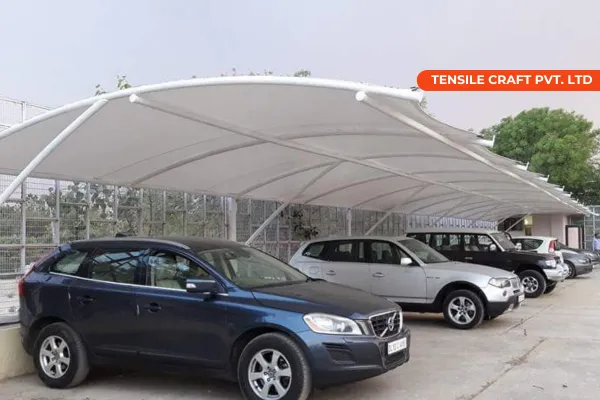
| 1 Car | 200-250 sq.ft. | Single Conical | ₹50,000 - ₹65,000 | ₹65,000 - ₹90,000 |
| 2 Cars | 350-450 sq.ft. | Twin Conical | ₹80,000 - ₹1,20,000 | ₹1,20,000 - ₹1,50,000 |
| 4 Cars | 800-1,000 sq.ft. | Hypar Row | ₹1,60,000 - ₹2,40,000 | ₹2,40,000 - ₹3,00,000 |
| 10 Cars | 2,000-2,500 sq.ft. | Barrel Vault Row | ₹3,50,000 - ₹5,50,000 | ₹5,50,000 - ₹7,50,000 |
| 25 Cars | 5,000-6,000 sq.ft. | Multi-Row | ₹8,00,000 - ₹14,00,000 | ₹14,00,000 - ₹20,00,000 |
| 50 Cars | 10,000-12,500 sq.ft. | Multi-Row + Central Aisle | ₹15,00,000 - ₹28,00,000 | ₹28,00,000 - ₹40,00,000 |
| 100 Cars | 20,000-25,000 sq.ft. | Multi-Level or Large Span | ₹28,00,000 - ₹55,00,000 | ₹55,00,000 - ₹85,00,000 |
Budget vs Premium: "Budget" uses standard conical/hypar design, PVC+PVDF fabric, MS pipes with standard galvanizing, and simple foundations. "Premium" includes custom architectural design, upgraded steel sections, enhanced galvanizing or duplex coating, and optional upgrades like LED edge lighting or printed fabric.
For the complete car parking guide including designs and installation process, see our Tensile Car Parking Ultimate Guide.
Tensile vs Concrete: Cost Comparison
This is the comparison that matters most to decision-makers:
| For 2,000 sq.ft. (10 Cars) | Tensile Structure | Concrete Shed | Metal Shed (CGI) |
|---|---|---|---|
| Total Cost | ₹3.5 - 7.5 lakhs | ₹6 - 10 lakhs | ₹2.5 - 4 lakhs |
| Cost per sq.ft. | ₹175 - ₹375 | ₹300 - ₹500 | ₹125 - ₹200 |
| Installation Time | 10-15 days | 60-90 days | 15-25 days |
| Structure Life | 15-30 years | 30-50 years | 5-10 years |
| UV Protection | UPF 50+ | None (open sides) | None |
| 20-Year Total Cost* | ₹4.5 - 9.5 lakhs | ₹10 - 16 lakhs | ₹8 - 15 lakhs |
*20-year total cost includes initial construction + annual maintenance + one fabric replacement at year 15-20 for tensile, and periodic waterproofing/repairs for concrete and metal.
Even with the fabric replacement factored in, tensile structures cost 40-55% less than concrete over a 20-year lifecycle. And they deliver benefits (UV protection, modern aesthetics, natural ventilation) that concrete simply cannot match. The 15 benefits of tensile structures are detailed in our Benefits of Tensile Structures in 2026 article.
8 Proven Ways to Reduce Your Cost
These are strategies we recommend to clients at Tensile Craft — they work because we have implemented them on hundreds of projects:
- Choose a standard design — Conical, hypar, and barrel vault are our most optimized designs with proven CNC patterns and efficient steel usage. Custom free-form designs cost 20-40% more due to additional engineering and higher fabric wastage.
- Order for multiple bays together — A 20-car parking ordered as one project costs 10-15% less per sq.ft. than four separate 5-car orders. The savings come from bulk steel procurement, shared design overhead, and faster installation turnaround.
- Use PVC + PVDF, not PTFE — For 90% of projects, PTFE is unnecessary. PVC+PVDF provides the same UV protection at half the fabric cost. Read our PTFE vs PVC comparison to determine if your project truly needs PTFE.
- Stick to MS steel with galvanizing — Stainless steel costs 3x more and is unnecessary for most Indian environments. Hot-dip galvanized MS with powder coating provides 40+ years of corrosion protection.
- Optimize column spacing — Standard column spacing of 5-6 meters is the sweet spot for cost efficiency. Going wider (8m+) requires significantly heavier beams. Going narrower (3-4m) uses more steel per sq.ft. than necessary.
- Plan installation in non-monsoon months — October to May is ideal. Monsoon installation (July-September) may need rain covers, additional safety measures, and potential overtime, adding 10-15% to installation cost.
- Prepare the site before mobilization — Ensure the site is levelled, underground utilities are marked, and access is clear before the installation crew arrives. Delays caused by site unreadiness add ₹5,000-10,000 per idle day.
- Combine structures in one order — If your society needs car parking + walkway covering + entrance canopy, order them together. One mobilization, one design cycle, one fabrication batch = significant savings.
Real Saving Example: A housing society in Dwarka, Delhi needed 40 car parking bays. By ordering as one project (instead of 8 separate 5-car orders), choosing standard conical design, and scheduling installation in February, they saved approximately ₹4.5 lakhs compared to the initial per-bay quotation — a 22% reduction.
Hidden Costs to Watch For
These are costs that are rarely discussed upfront but can add 10-20% to your project if you are not aware:
- Demolition and site clearance: If an old shed or structure needs to be removed first — ₹10,000-50,000 depending on size
- Underground utilities: If electric cables, water pipes, or sewer lines are found during foundation excavation, re-routing adds ₹5,000-25,000 per instance
- Rocky terrain: Excavation in rocky soil costs 3-5x more than normal soil — ₹8,000-15,000 per footing vs ₹3,000-5,000
- Municipal permissions: Some cities require building permits for structures above certain heights or sizes — fees vary from ₹2,000-50,000
- Access restrictions: If the site has narrow entry gates, low overhead clearances, or weight-restricted pathways, special logistics add ₹10,000-30,000
- Re-fabrication due to site changes: If site dimensions change after fabrication has started, re-cutting fabric or modifying steel adds 15-25% of the affected component cost
- Sales tax / GST variations: Ensure your quotation clearly states whether GST (18%) is included or extra — this alone can be a ₹60,000+ difference on a ₹5 lakh project
Tensile Craft Policy: Our quotations are always all-inclusive (design + material + fabrication + installation + GST). The only exclusions we state upfront are: (1) civil foundation if provided by the client's contractor, (2) municipal permissions, (3) demolition of existing structures. No surprises.
Annual Maintenance Cost
The ongoing cost of owning a tensile structure is minimal — this is one of its key advantages over conventional roofing:
| Maintenance Task | Frequency | Cost (2,000 sq.ft.) |
|---|---|---|
| Visual inspection | Monthly | DIY (free) |
| Fabric cleaning | 2-4 times/year | ₹1,000 - ₹2,500 per cleaning |
| Bolt tightening | Quarterly (first year) | DIY or ₹500 - ₹1,000 |
| Paint touch-up (steel) | As needed | ₹500 - ₹2,000 per year |
| Professional inspection | Annually | ₹2,000 - ₹5,000 |
| Total Annual Cost | — | ₹4,000 - ₹10,000 |
| Cost per sq.ft. per year | — | ₹2 - ₹5 |
Compare this to concrete roofing: ₹8-25 per sq.ft. per year (waterproofing, crack repair, painting) or metal roofing: ₹5-12 per sq.ft. per year (rust treatment, re-fastening, leak repair). For detailed maintenance procedures, read our 20 Expert Maintenance Tips.
Get a Written Quotation — No Hidden Costs
Every Tensile Craft quotation is itemised: steel, fabric, foundation, installation, GST — you see exactly where every rupee goes.
Call: +91-9217718546Frequently Asked Questions
What is the cost of tensile structure per sq.ft. in India?
Tensile structure cost in India ranges from ₹75 to ₹900 per sq.ft. depending on type: umbrella structures cost ₹75-150/sq.ft., car parking costs ₹175-400/sq.ft., walkway coverings cost ₹200-350/sq.ft., membrane roofs cost ₹350-700/sq.ft., and dome structures cost ₹500-900/sq.ft. These are all-inclusive rates covering design, fabrication, and installation.
What is the cost of tensile car parking for 10 cars?
A tensile car parking structure for 10 cars (approximately 2,000-2,500 sq.ft.) costs ₹3.5 to ₹7.5 lakhs in 2026. This includes design, steel fabrication with galvanizing, PVC fabric membrane, foundation work, and complete installation. Cost per car comes to approximately ₹35,000-75,000.
Is tensile structure cheaper than concrete?
Yes, significantly. Tensile structures cost 40-55% less than concrete for equivalent coverage. A 2,000 sq.ft. car parking shed in concrete costs ₹6-10 lakhs and takes 2-3 months. The same in tensile costs ₹3.5-7.5 lakhs and installs in 10-15 days.
Does tensile structure cost vary by city in India?
Yes. Metro cities (Delhi, Mumbai, Bangalore, Hyderabad, Pune) have the most competitive rates at ₹75-400/sq.ft. Tier-2 cities (Jaipur, Lucknow, Chandigarh, Indore) are 5-10% higher due to logistics. Tier-3 cities and remote locations can be 10-20% higher. Northeast India and island territories attract additional logistics surcharges.
How can I reduce tensile structure cost?
Five proven ways: (1) Choose standard conical design instead of custom shapes — saves 15-20%. (2) Use PVC fabric instead of PTFE — saves 30-40% on fabric cost. (3) Order for multiple bays together — bulk orders reduce per-unit cost by 10-15%. (4) Opt for powder-coated MS steel instead of stainless steel — saves 60-70% on steel cost. (5) Plan installation during non-monsoon months — avoids weather delays and overtime charges.
What is the maintenance cost of tensile structure per year?
Annual maintenance cost for a tensile structure is approximately ₹2-5 per sq.ft. For a 2,000 sq.ft. car parking structure, this means ₹4,000-10,000 per year. This includes periodic fabric cleaning (2-4 times/year), bolt tightening, and paint touch-up on scratched steel areas. PTFE fabrics need even less maintenance due to self-cleaning properties.
Related Articles
Continue reading more about tensile structures
Top 15 Benefits of Tensile Structures in 2026
Why tensile structures save 30-50% cost, install 5x faster, and outperform conventional construction.
Benefits
PTFE vs PVC Tensile Fabric Comparison
How fabric choice impacts your total cost — ₹73,000+ difference for a standard project.
Materials
Tensile Car Parking: Ultimate Guide
Designs, installation process, and detailed pricing for 1 to 100+ car parking structures.
Car Parking