

Table of Contents
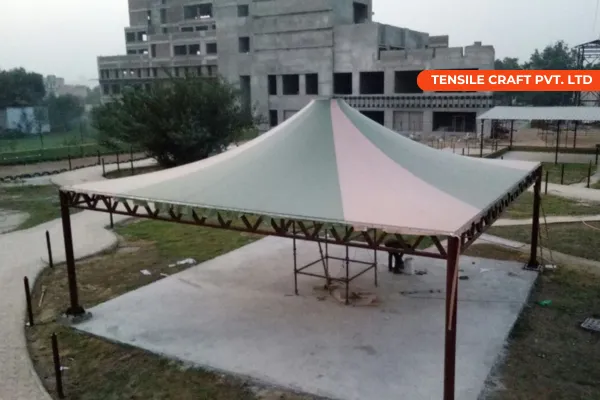
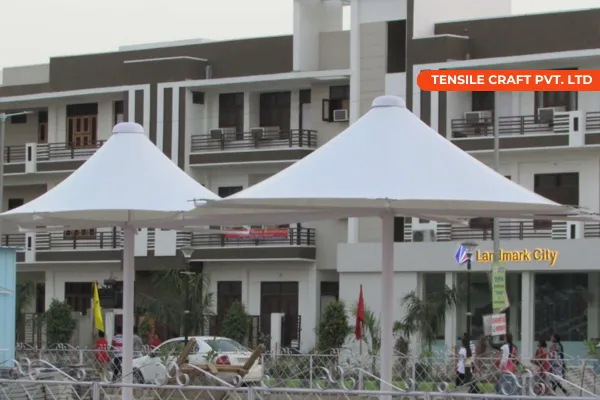
While a tensile umbrella uses a single central mast, a tensile gazebo structure uses four or more vertical columns placed at the corners, supporting a fabric roof between them. This design provides flat, usable floor space right up to the edges, making it the preferred choice for garden seating, outdoor restaurants, and residential lawns.
Key Difference: Umbrellas have a single point of failure (the mast). Gazebos distribute loads across 4-6 columns. If one column's foundation settles slightly, the fabric tension can usually accommodate the shift. However, gazebos require precise corner plate alignment to prevent fabric wrinkling.
1. Gazebo vs Umbrella: The Structural Difference
The gazebo structure works primarily on a grid system. Unlike a conical umbrella where water runs off all sides, a gazebo roof must be carefully shaped to direct water toward specific edge drainage points. This requires anticlastic shaping—alternating high and low corners—to ensure water flows to the low points and doesn't pool in the center.
- Umbrella: 1 mast, radial tension, 360° runoff.
- Gazebo: 4+ masts, edge cable tension, directional runoff to low corners.
2. Popular Gazebo Designs
A. Square/Rectangular Hypar Gazebo (Most Common)
Four columns with two diagonally opposite corners set higher than the others. The fabric stretches between them creating a saddle shape. Extremely stable in wind and sheds water efficiently at the two low corners. Standard sizes are 3x3m, 4x4m, and 5x5m.
B. Hexagonal/Octagonal Gazebo
Six or eight columns arranged in a circle, supporting a cone-like fabric roof. This mimics the look of a traditional wooden gazebo but with a sleek, modern tensile membrane. Requires precise fabric patterning (gores) to avoid wrinkles at the column connection points. Often used in pool environments.
C. Multi-Bay Gazebo Cluster
Multiple 4-post gazebo modules connected together with shared intermediate columns and gutter systems. This allows covering large areas (like wedding lawns or café terraces) without the massive spans required by barrel vaults or domes.
3. Corner Plates & Edge Tensioning
The most critical engineering detail in a gazebo is the corner connection. The fabric converges at the column top, creating immense concentrated force.
Engineering Detail — Corner Plate Dynamics: At a gazebo corner, two edge cables meet the column. The resultant force pulls both downward AND inward. The column head plate must be designed to resist this diagonal pull without bending. We use 12mm thick MS base plates with gusset ribs to distribute this load into the column tube (IS 1239 pipe). The edge cables are typically SS 316, 10-16mm diameter, tensioned using forged turnbuckles.
4. Cost by Size (2026)
| Size (Columns) | Coverage Area | Design | Total Cost (Installed) |
|---|---|---|---|
| 3m x 3m (4 cols) | 9 sq.m (97 sq.ft.) | Hypar Saddle | ₹35,000 - ₹55,000 |
| 4m x 4m (4 cols) | 16 sq.m (172 sq.ft.) | Hypar Saddle | ₹60,000 - ₹90,000 |
| 5m x 5m (4 cols) | 25 sq.m (270 sq.ft.) | Hypar Saddle | ₹85,000 - ₹1,30,000 |
| 6m x 6m (4 cols) | 36 sq.m (388 sq.ft.) | Hypar Saddle | ₹1,20,000 - ₹1,80,000 |
For complete pricing, visit our Tensile Structure Cost India 2026 page.
Get a Custom Gazebo Quote
Tell us your garden or terrace dimensions — we will design a modular gazebo system for you.
Call: +91-9217718546Frequently Asked Questions
What is the cost of a tensile gazebo in India?
A standard 3x3m tensile gazebo costs ₹35,000-₹55,000. A large 6x6m gazebo for gardens or restaurants costs ₹1,20,000-₹1,80,000. Costs depend on fabric type, column height, and foundation requirements.
Which is better: tensile umbrella or gazebo?
It depends on the space. A tensile umbrella is better for round spaces and where a single central column isn't an obstruction. A gazebo is better for square/rectangular spaces (like garden corners) where you need clear access from the edges. Gazebos distribute loads across 4 columns, making foundations slightly easier than the heavy single-block foundation of an umbrella.
Related Articles
Continue reading about tensile structures