

Table of Contents
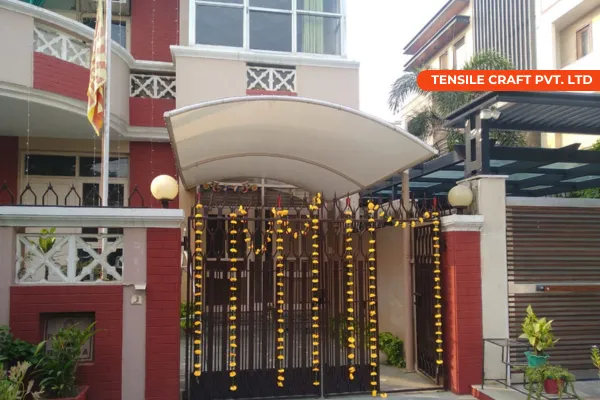
Unlike free-standing umbrellas or gazebos, an awning or canopy structure relies partially or entirely on a building's facade for support. This makes them highly efficient for entrances, windows, and walkways where floor space cannot be consumed by columns, but it introduces the critical engineering challenge of facade load transfer.
Quick Engineering Fact: A 1.5m projecting canopy in Delhi (Wind Zone II) experiences approximately 40-50 kg of uplift force per square meter during a storm. If your canopy is 5m long, that is 450+ kg of upward pull trying to rip the brackets out of the wall. This is why chemical anchor bolts into RCC beams are mandatory—rawl bolts into brick walls will fail.
1. What is an Awning/Canopy Structure?
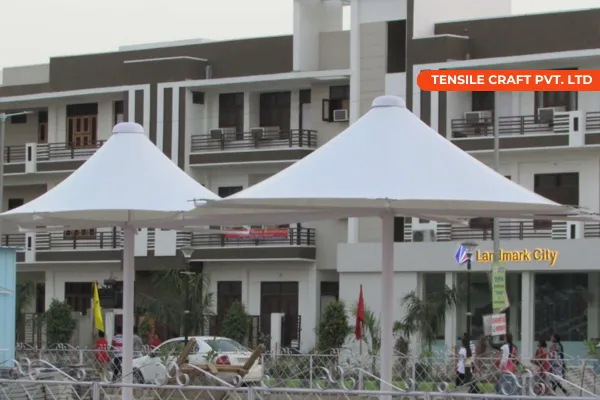
An awning is a roof-like cover extending from a building facade, typically supported by a steel framework bolted to the wall. A canopy is a larger, often freestanding or partially building-supported structure used to cover entrances or walkways. Both use tensile PVC/PTFE fabric or polycarbonate sheets as the roofing material.
2. Facade Engineering: The Hidden Challenge
The most dangerous mistake in awning installation is failing to assess the building's structural capacity. An awning transfers three types of load to the facade:
- Vertical Downward Load (Dead Load + Snow/Rain): The weight of the steel, fabric, and pooled water pulls the brackets downward.
- Vertical Upward Load (Wind Uplift): Wind getting under the canopy acts like an airplane wing, pulling the awning upward.
- Horizontal Pull (Overturning Moment): Because the awning projects outward, the wind creates a lever effect (moment) that tries to rotate the bracket downward and outward simultaneously.
Engineering Detail — Chemical Anchoring: We specify HILTI HIT-RE 500 V3 or equivalent epoxy chemical anchors for all facade connections. The anchor must embed at least 100-125mm into solid concrete (RCC beam/column). Minimum edge distance (distance from anchor to edge of concrete) must be 75mm+ to prevent concrete spalling under tension. Brick wall mounting is only permitted for very small, non-load-bearing decorative awnings.
3. Fixed vs Retractable Systems
A. Fixed Tensile Canopies (Most Common)
Steel framework welded and bolted in place, with fabric permanently tensioned. Provides 100% protection 24/7. Can span up to 5m+ from the facade with the addition of front cables or struts. Used for entrance canopies and permanent walkways.
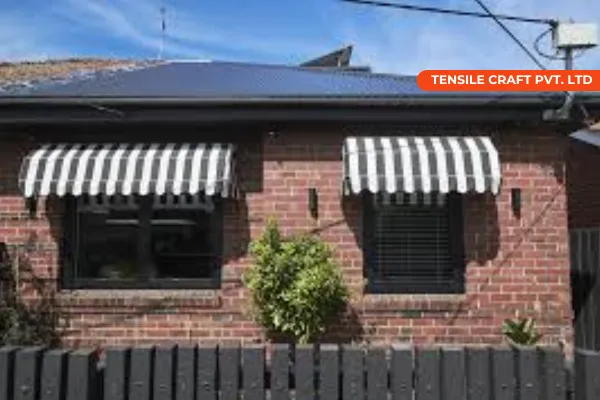
B. Retractable Awnings (Folding Arm)
Aluminum frames with articulated arms (springs or gas struts) that allow the fabric to roll out when needed and retract back against the wall when not in use. Maximum safe projection is typically 1.2m - 1.8m. Must be retracted during high winds (>60 km/h) to prevent arm failure. Ideal for residential balconies and café patios.
4. Wind Uplift & Cantilever Limits
How far can an awning project without front support posts? It depends on the wind zone and the facade strength.
| Cantilever Projection | Structural Requirement | Risk Level |
|---|---|---|
| 0 - 1.2m | Wall brackets only (Chemical anchors into RCC) | Low |
| 1.2m - 1.8m | Wall brackets + tension cables to wall (higher anchor point) | Moderate |
| 1.8m - 3.0m | Wall brackets + diagonal struts to ground or front columns | High (Requires precise engineering) |
| 3.0m+ | Freestanding portal frame or walkway structure | Very High (Cantilever not recommended) |
⚠ Warning — The 1.8m Rule: Never cantilever a fixed awning more than 1.8m from the facade without front support (struts or columns) in Delhi NCR or coastal India. Wind uplift forces multiply exponentially with projection length. Exceeding this limit with only wall brackets risks catastrophic failure during storms, endangering people below.
5. Cost Analysis (2026)
| Type | Size (Projection x Length) | Total Cost (Installed) |
|---|---|---|
| Door Window Awning | 1.0m x 1.5m | ₹8,000 - ₹12,000 |
| Retractable Balcony Awning | 1.5m x 4.0m | ₹25,000 - ₹40,000 |
| Fixed Entrance Canopy | 1.8m x 3.0m | ₹35,000 - ₹55,000 |
| Large Facade Canopy (w/ Struts) | 2.5m x 8.0m | ₹1,20,000 - ₹1,80,000 |
Get a Facade Assessment
Our team will inspect your building wall (RCC or Brick) and design a safe anchoring system for your canopy.
Get Free QuoteFrequently Asked Questions
How far can a tensile awning cantilever without support?
A standard tensile awning cantilever can safely span 1.2m to 1.8m without front supports using wall brackets and upper tension cables. Beyond 1.8m projection, diagonal struts or front columns are mandatory to resist wind uplift and overturning moments.
Can awnings be installed on brick walls?
Only very small, lightweight decorative awnings (under 1.0m projection) can be mounted on solid brick walls using heavy-duty rawl bolts. For larger structural canopies, chemical anchors into RCC beams/columns are mandatory. Brick cannot safely resist the cyclic wind uplift loads of a large canopy.
Related Articles
Continue reading about tensile structures