


Table of Contents
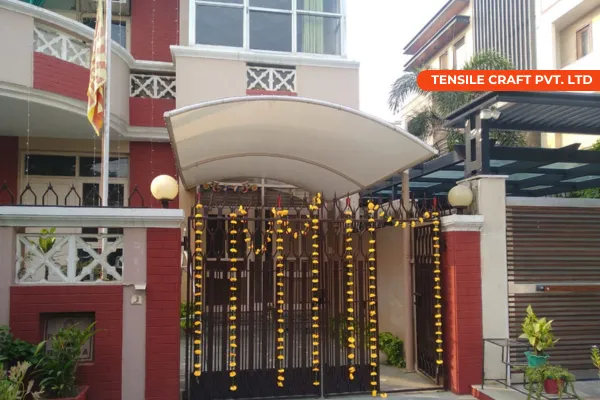
A building's entrance is its handshake—it sets the tone for the entire structure. A tensile entrance structure provides a striking, modern identity while offering functional protection from rain and sun. Unlike standard awnings that simply project horizontally, entrance canopies are sculptural architectural statements.
At Tensile Craft, we engineer entrance canopies that appear to float effortlessly, cantilevering up to 3-5 meters from the facade without visible front supports. This illusion of weightlessness requires precise engineering—managing massive wind uplift forces and transferring them safely into the building's RCC frame.
Key Engineering Fact: A tensile entrance canopy isn't just a roof; it's a cantilevered sail anchored to a building. In a 47 m/s wind (Delhi Zone II), a 5m x 3m entrance canopy experiences over 2,500 kg of upward uplift force. This force is concentrated at the 4-6 facade anchor points, which is why chemical anchoring into structural beams is strictly mandatory.
1. The Architectural Role of Entrance Structures
While car parking structures prioritize utility, entrance structures prioritize aesthetics and brand identity. The fabric acts as a massive, illuminated signboard at night and a welcoming shelter during the day.
- Visual Identity: The curved fabric softens the hard lines of glass-and-concrete buildings.
- Translucency: PVDF-coated PVC allows 10-15% light transmission, creating a soft, shadow-free glow over the entrance lobby.
- Weather Protection: Keeps rain and direct sun off visitors and prevents water from tracking into the lobby.
2. Wind Venturi Effect at Building Corners
Entrance canopies are uniquely vulnerable to wind because they are typically located at the base of tall buildings. Wind hitting a high-rise facade accelerates downward and rushes outward at ground level—a phenomenon called the venturi effect or downwash.
Engineering Detail — Downwash & Cornering: At the corner of a 30m+ tall building, the local wind speed at the entrance canopy level can be 20-30% higher than the ambient wind speed. IS 875 Part 3 requires a pressure coefficient (Cp) of -2.0 to -2.5 for canopies at building corners, compared to -1.2 for freestanding structures. This means we must design entrance canopies for significantly higher uplift forces than standalone umbrellas.
3. Facade Loading & Chemical Anchoring
The most critical part of an entrance canopy isn't the fabric—it's the connection to the building. The awning transfers three forces to the facade: vertical downward load, vertical upward load (uplift), and horizontal overturning moment.
- RCC Beams/Columns (Safe): We use HILTI HIT-RE 500 V3 epoxy chemical anchors, embedded 100-125mm deep. Minimum edge distance from concrete edge is 75mm to prevent spalling.
- Brick Walls (Dangerous): Rawl bolts into brick will slowly pull out under cyclic wind loads. We refuse to install structural canopies on brick walls.
- Steel Portals (Alternative): If the facade cannot take the load, we install freestanding steel portal frames anchored to the ground, independent of the building.
💰 Cost-Saving Tip: If your building has exposed RCC columns at the entrance, we can use them as mounting points, eliminating the need for freestanding steel portals and saving ₹30,000-₹50,000 on structural steel.
4. 5 Signature Entrance Designs
A. The Classic Hypar (Saddle)
Two high points anchored high on the facade, two low points projecting outward. The twisted fabric creates a dynamic, contemporary look. The most popular choice for corporate offices in Gurugram and Bangalore.
B. The Cantilevered Cone
A half-cone projecting from the wall, draining water to the sides rather than the front edge. Excellent for hotels and hospitals where you want zero dripping at the drop-off point.
C. The Wave/Cascade
A series of undulating curves mounted on a long facade, covering multiple entrance bays. Perfect for convention centers and IT parks.
D. The Tensile Gazebo Portico
A freestanding gazebo structure placed directly outside the entrance doors, connected to the building by a short fabric walkway link.
E. Parabolic Arch
A high arch creating a grand, imposing entrance—often used for temples, museums, and premium residential towers.
5. LED Lighting Integration
Tensile fabric is translucent, making it the perfect canvas for nighttime lighting. However, standard floodlights create hotspots (bright dots on the fabric). We use two specific techniques:
- Perimeter LED Coving: LED strips are hidden inside the steel framework, washing light across the underside of the fabric for a smooth, continuous glow.
- Uplighting from Ground: Buried uplights at the base of the columns light the canopy from below, creating a dramatic floating effect.
6. Cost Analysis by Size (2026)
| Size (Projection x Length) | Design Type | Facade Mounting | Total Cost (Installed) |
|---|---|---|---|
| 1.5m x 2.0m | Flat/Hypar | Chemical Anchors | ₹25,000 - ₹40,000 |
| 2.5m x 4.0m | Hypar Saddle | Chemical Anchors + Upper Cables | ₹60,000 - ₹90,000 |
| 3.5m x 6.0m | Cantilevered Cone | Freestanding Portal Frame | ₹1,50,000 - ₹2,20,000 |
| 5.0m x 10.0m | Wave/Cascade | Structural Steel Portal | ₹3,50,000 - ₹5,00,000 |
For complete pricing across all types, see our Tensile Structure Cost India 2026 guide.
Design Your Entrance Canopy
Share your building facade photos — we will design a custom tensile entrance with 3D renders and engineering details.
Get Free ConsultationFrequently Asked Questions
What is a tensile entrance structure?
A tensile entrance structure is a canopy system mounted to a building facade, using high-strength fabric (PVC/PTFE) tensioned over a steel frame to cover building entrances. It provides weather protection, UV shielding, and architectural identity while allowing natural light transmission.
How much does a tensile entrance canopy cost?
A tensile entrance canopy costs ₹350-550 per sq.ft. in India. A standard 3m x 2m residential entrance costs ₹25,000-₹40,000. Large commercial entrance canopies (5m x 5m+) with LED lighting cost ₹1,00,000-₹2,50,000 depending on design complexity and facade connection requirements.
How is a tensile canopy attached to a building wall?
Tensile canopies are attached using chemical anchor bolts (like HILTI HIT-RE 500) embedded 100-125mm deep into RCC beams or columns. Brick wall mounting is only permitted for very small decorative awnings. The steel brackets must resist both vertical downward loads and wind uplift overturning moments.
Can tensile entrance structures withstand high winds?
Yes, if engineered correctly. Building corners experience a 'venturi effect' where wind speeds accelerate by 20-30%. Tensile Craft designs entrance structures with upper tie-back cables and diagonal struts to resist this localized wind uplift, ensuring the canopy remains stable even in 150 km/h gusts.
Which fabric is best for entrance canopies?
PVDF-coated PVC is the best choice for most entrances due to its self-cleaning properties, translucency (10-15% light transmission), and color options. For premium corporate buildings, PTFE fiberglass provides a brilliant white appearance, A-grade fire rating, and a 25-30 year lifespan.
Can LED lights be integrated into tensile entrances?
Yes. Tensile fabric acts as a natural diffuser for LED strip lights. We integrate perimeter LED coving or under-mast uplighting into the steel framework. This creates a uniform, glowing architectural effect at night without visible light fixtures or hotspots.
Related Articles
Continue reading about tensile structures
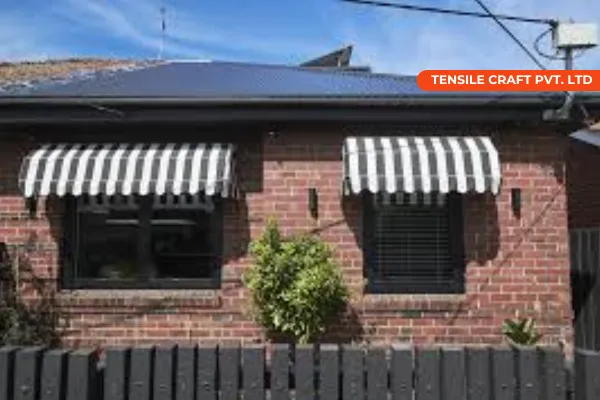
Awning & Canopy Structure Guide
Wall-mounted structures and cantilever engineering for windows and walkways.
Awnings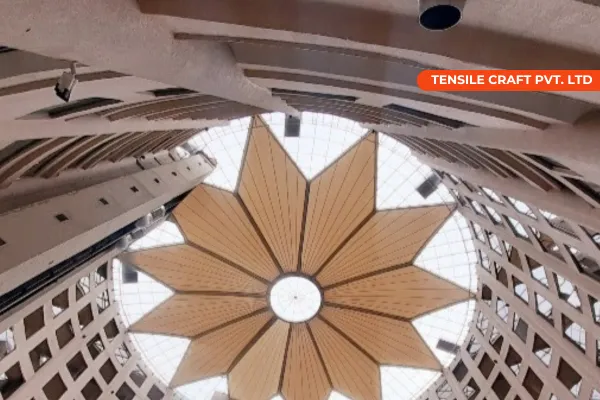
Tensile Roof Structure Guide
Large span barrel vaults and hyperbolic roofs for commercial spaces.
Roofs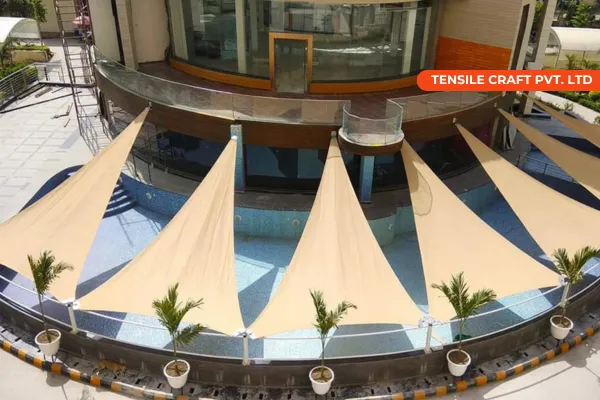
Tensile Architecture Design Trends
Future trends and modern design philosophy for tensile structures.
Architecture