

Table of Contents
- Why Fabric Choice Matters Most
- What is PVC Tensile Fabric?
- What is PTFE Tensile Fabric?
- Head-to-Head Comparison (15 Parameters)
- Real Cost Analysis for Indian Projects
- The PVDF Factor — Why It Changes Everything
- When to Choose PVC
- When to Choose PTFE
- What About Other Fabrics?
- Frequently Asked Questions
The fabric membrane is the single most important component of any tensile structure. It determines how long your structure will last, how it will perform in Indian weather, how much it will cost, and how it will look. Yet, most buyers focus only on the steel — which is actually the replaceable part — and treat the fabric as an afterthought.
In India, the fabric decision boils down to two options: PVC-coated polyester and PTFE-coated fiberglass. At Tensile Craft, we have worked with both fabrics across hundreds of installations, and this article presents our real-world findings — not marketing brochures from fabric suppliers.
Bottom Line First: For 90% of Indian projects, PVC with PVDF top coat is the correct choice — it costs half as much, comes in colours, and provides 15-20 years of reliable service. PTFE is justified only for landmark architectural projects, coastal environments, or when a 30-year non-maintenance lifespan is contractually required.
What is PVC Tensile Fabric?
PVC-coated polyester (Polyvinyl Chloride on polyester base cloth) is the workhorse fabric of the tensile industry worldwide. It accounts for approximately 80% of all tensile fabric installations globally, and an even higher percentage in India.
How It Is Made
Polyester yarns (similar to seatbelt material) are woven into a base cloth with a specific weight — typically 650-1100 grams per square meter (gsm). This woven cloth is then coated on both sides with liquid PVC paste in a process called knife-over-roll coating. The PVC penetrates the weave, bonds to the polyester fibers, and creates a waterproof, UV-resistant membrane.
Key Specifications (Indian Market Standard)
- Base cloth: High-tenacity polyester, 1100 dtex (most common), woven panama or plain weave
- Total weight: 650-1100 gsm (typical: 800-950 gsm for car parking and canopies)
- Tensile strength: 3000-5000 N/5cm (warp) and 2800-4500 N/5cm (weft) as per IS 6746
- Elongation at break: 15-25%
- Top coat options: Acrylic (basic), PVDF (recommended), TiO2 (for self-cleaning variant)
- Fire rating: B1 (DIN 4102) — self-extinguishing, does not support flame spread
- Light transmission: 8-15% (depending on colour — white transmits more, dark colours less)
- Colours available: White, off-white, beige, grey, blue, green, red, custom colours (MOQ applies)
Indian Suppliers
PVC tensile fabric is widely available from Indian distributors of international brands like Serge Ferrari (France), Mehler (Germany), Sattler (Austria), and Halyard (USA), as well as from Chinese and domestic manufacturers. At Tensile Craft, we primarily source from Mehler and Serge Ferrari for quality-critical projects, with Chinese options available for budget-sensitive applications.
What is PTFE Tensile Fabric?
PTFE-coated fiberglass (Polytetrafluoroethylene on fiberglass base cloth) is the premium architectural membrane. It was invented by DuPont in the 1960s and has been used in iconic structures worldwide — the Denver Airport terminal, the Beijing Water Cube, and the Jedah Football Stadium, to name a few.
How It Is Made
Fiberglass yarns are woven into an extremely stable base cloth (typically 400-1500 gsm before coating). This cloth is then coated with PTFE dispersion and sintered at approximately 400°C in a continuous oven. The sintering process fuses the PTFE to the fiberglass, creating a chemically inert, non-stick, self-cleaning membrane.
Key Specifications
- Base cloth: Fiberglass, typically 9x9 or 12x12 ends/picks per cm
- Total weight: 800-1500 gsm (typical: 1000-1200 gsm for architectural applications)
- Tensile strength: 5000-8000 N/5cm (significantly stronger than PVC due to fiberglass)
- Elongation at break: 3-8% (very low — fabric does not stretch much, making form-finding more critical)
- Fire rating: A (DIN 4102, NFPA 701) — non-combustible, will not burn, does not produce flaming droplets
- Light transmission: 10-25% (natural off-white colour; more translucent than PVC)
- Colours available: Only off-white/cream (PTFE cannot be pigmented effectively — the natural colour is the only option)
- Self-cleaning: Yes — PTFE has extremely low surface energy, dirt does not adhere
Indian Suppliers
PTFE fabric is not manufactured in India. It is imported from Chemfab (India's distributor for international brands), or directly from manufacturers like Serge Ferrari (Gore Tenara), Birdair (now Structura), and Saint-Gobain. Lead time is typically 6-10 weeks from order to delivery, compared to 1-3 weeks for PVC.
Head-to-Head Comparison: 15 Parameters
This is the most detailed comparison table available for Indian project decision-making:
| Parameter | PVC + PVDF | PTFE |
|---|---|---|
| Full Form | Polyvinyl Chloride on Polyester | Polytetrafluoroethylene on Fiberglass |
| Fabric Cost (per sq.m.) | ₹350 - ₹600 | ₹800 - ₹1,200 |
| Lifespan | 15-20 years | 25-30 years |
| UV Resistance | Good (with PVDF top coat) | Excellent (inherent to PTFE) |
| Self-Cleaning | No (PVDF reduces dirt pickup by 50-60%) | Yes (rain washes away dirt automatically) |
| Fire Rating | B1 — self-extinguishing | A — non-combustible |
| Light Transmission | 8-15% | 10-25% |
| Colour Options | Wide range (10+ standard colours) | Off-white only |
| Tensile Strength | 3000-5000 N/5cm | 5000-8000 N/5cm |
| Elongation | 15-25% (forgiving during installation) | 3-8% (precise installation required) |
| Temperature Range | -30°C to +70°C | -40°C to +80°C (broader range) |
| Chemical Resistance | Moderate (affected by strong acids, solvents) | Excellent (resists virtually all chemicals) |
| Welding Method | High-frequency (RF) or hot air | Hot air only (slower, more precise) |
| Availability in India | Ready stock, 1-3 weeks | Import only, 6-10 weeks |
| Fabric Replacement Cost | 25-35% of original project cost | 20-30% of original project cost |
Real Cost Analysis for Indian Projects
The fabric cost difference matters, but what matters more is the total project cost impact. Here is a realistic comparison for a 2,000 sq.ft. tensile car parking structure in Delhi NCR:
| Cost Component | PVC + PVDF Option | PTFE Option | Difference |
|---|---|---|---|
| Fabric Membrane | ₹65,000 - ₹1,10,000 | ₹1,50,000 - ₹2,20,000 | +₹85,000 - ₹1,10,000 |
| Steel Framework | ₹80,000 - ₹1,50,000 | ₹80,000 - ₹1,50,000 | Same |
| Foundation | ₹40,000 - ₹60,000 | ₹40,000 - ₹60,000 | Same |
| Design & Engineering | ₹20,000 - ₹40,000 | ₹30,000 - ₹50,000 | +₹10,000 (PTFE needs more precise form-finding) |
| Fabrication & Installation | ₹60,000 - ₹1,20,000 | ₹80,000 - ₹1,40,000 | +₹20,000 (PTFE welding is slower) |
| Total Project Cost | ₹2,65,000 - ₹4,80,000 | ₹3,80,000 - ₹6,20,000 | +₹1,15,000 - ₹1,40,000 |
| Cost per sq.ft. | ₹133 - ₹240 | ₹190 - ₹310 | +40-45% |
Key insight: PTFE increases total project cost by approximately 40-45%, not just the fabric cost by 2-3x. This is because the fabric is only one component — but the absolute rupee increase is significant: ₹1-1.5 lakhs more for a 2,000 sq.ft. structure.
For the complete pricing breakdown across all structure types, see our Tensile Structure Cost in India 2026 guide.
Not Sure Which Fabric to Choose?
Tell us your project type, location, and budget — we will recommend the right fabric with a detailed justification.
Get Free RecommendationThe PVDF Factor — Why It Changes Everything
When comparing PVC and PTFE, most people compare standard PVC (with acrylic top coat) against PTFE — and conclude PTFE is vastly superior. This is an unfair comparison because no reputable tensile manufacturer in India uses standard PVC for outdoor applications anymore.
The correct comparison is PVC + PVDF versus PTFE. Here is what PVDF does:
- PVDF (Polyvinylidene Fluoride) is a fluoropolymer top coat applied over the PVC surface during manufacturing
- It reduces dirt accumulation by 50-60% compared to acrylic-coated PVC
- It extends the fabric's effective life by 3-5 years by slowing UV degradation of the PVC layer underneath
- It prevents the "chalking" effect (white powder on the surface) that plain PVC develops after 5-7 years
- It adds approximately ₹30-50 per sq.m. to the fabric cost — a small price for significant performance improvement
At Tensile Craft, PVDF top coat is our standard specification for all outdoor PVC structures. We do not quote or supply acrylic-coated PVC unless the client explicitly requests it for a temporary or indoor application.
With PVDF, the gap between PVC and PTFE narrows significantly:
| Feature | PVC + PVDF | PTFE | Gap |
|---|---|---|---|
| Dirt Resistance | Good (PVDF) | Excellent (self-cleaning) | Moderate gap |
| UV Life | 15-20 years | 25-30 years | 5-10 years |
| Surface Chalking | Minimal (PVDF prevents it) | None | Small gap |
| Cost | ₹380-650/sq.m. | ₹800-1,200/sq.m. | 2x gap |
The remaining advantages of PTFE (self-cleaning, A-rated fire resistance, 30-year life) are real — but whether they justify 2x the cost depends entirely on your project context.
When to Choose PVC + PVDF
PVC with PVDF is the right choice for the following applications — which represent approximately 90% of all tensile projects in India:
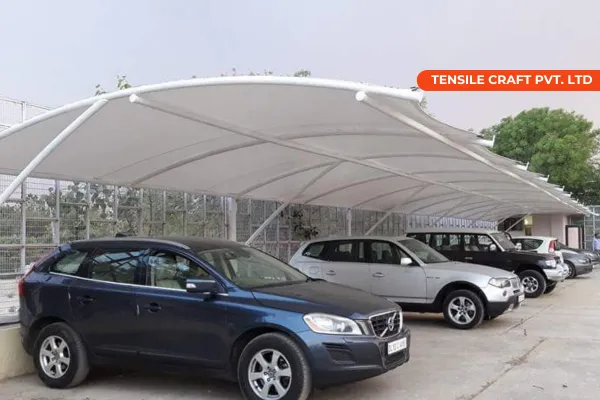
- Tensile car parking structures — residential societies, commercial complexes, corporate campuses. The colour options allow matching to building aesthetics. 15-20 year life is adequate. See our complete car parking guide.
- Walkway coverings — IT parks, hospitals, educational campuses. PVC handles foot-traffic environments well.
- Awnings and canopies — shop fronts, restaurants, balcony covers. Colour variety is essential for branding.
- Gazebo structures — gardens, resorts, luxury homes. Colour options enhance landscape design.
- Umbrella structures — cafes, outdoor seating, poolside. Colour options match commercial branding.
- Entrance canopies — offices, hotels, residential towers. PVC can match the building's facade colour.
- Swimming pool covers — residential and hotel pools. PVC handles chlorine-rich environments adequately for 15+ years.
- Industrial roofing — warehouses, factories, logistics hubs where cost is the primary driver.
Rule of Thumb: If your project needs colour, has a budget constraint, requires quick delivery, and has a 15-20 year performance requirement — PVC + PVDF is the correct, professional choice. It is not a "compromise" — it is the industry standard for these applications.
When to Choose PTFE
PTFE is justified in specific, high-value situations. Here is when we recommend it:
- Iconic architectural projects — airports, stadiums, museums, convention centers where the structure is a landmark. The superior aesthetics (pure white, translucent, self-cleaning) and 30-year life match the project's ambition. Dome structures for stadiums and membrane roofs for airports are classic PTFE applications.
- Coastal environments — within 2 km of the sea coast, salt spray accelerates degradation of PVC. PTFE's chemical inertness makes it virtually immune to salt corrosion. Goa, Mumbai marine drive, Chennai coastline, Kochi — these are PTFE-appropriate zones.
- Chemical industrial zones — factories producing or handling acids, solvents, or aggressive chemicals. PVC degrades on contact with many chemicals; PTFE resists virtually everything.
- Fire-critical public spaces — where local fire authorities mandate non-combustible (A-rated) roofing. PTFE is one of the few roofing materials that achieves this rating. This is common in airport terminals and large public assembly buildings.
- Maintenance-free requirements — projects where the owner cannot or will not arrange periodic cleaning. PTFE's self-cleaning property eliminates this need entirely for 25-30 years.
- Government and institutional projects — where 30-year lifecycle costing is mandatory in the bid evaluation and PTFE's longer life wins the total-cost-of-ownership comparison despite higher upfront cost.
Real Example: For a tensile car parking in Delhi residential society, PVC + PVDF saves ₹1-1.5 lakhs and provides colour matching to the building. The self-cleaning benefit of PTFE is irrelevant because the society's housekeeping will clean the cars and parking area anyway. This is why PTFE is rarely used for car parking — not because it is inferior, but because it is unnecessary for the application.
What About Other Fabrics?
Beyond PVC and PTFE, you may encounter these alternatives in the Indian market:
HDPE (High-Density Polyethylene)
Woven shade net fabric, costing ₹80-200 per sq.m. Used for agricultural shade nets, temporary event structures, and basic outdoor shading. Lifespan of 5-10 years. Not suitable for engineered tensile fabric structures because it cannot be tensioned or welded into precise 3D forms. It is a shade net, not a structural membrane.
ETFE (Ethylene Tetrafluoroethylene)
Transparent fluoropolymer film, used as individual air-inflated cushions (not tensioned membranes). Famous for the Beijing Water Cube. Cost: ₹2,000-4,000 per sq.m. Extremely durable (30+ years) but requires a specialized cushion system with constant air pressure monitoring. Very few installations in India. Not a direct alternative to PVC or PTFE — it is a completely different technology.
Silicone-coated Glass Fiber
A niche alternative to PTFE with similar performance but better light transmission. Used primarily in Europe. Not commonly available in India and offers no significant advantage over PTFE for Indian conditions. We do not recommend it for Indian projects due to sourcing difficulty and lack of local technical support.
PVC with TiO2 (Self-Cleaning Variant)
Some manufacturers offer PVC fabric with a titanium dioxide (TiO2) top coat that provides partial self-cleaning through photocatalytic action. It costs 15-20% more than standard PVDF PVC and provides some self-cleaning benefit, but it is not equivalent to PTFE's non-stick property. At Tensile Craft, we consider it a marketing feature more than a meaningful performance upgrade for Indian conditions.
Discuss Fabric Selection With an Expert
Our engineering team can analyse your project requirements and recommend the optimal fabric — with a technical justification document.
Call: +91-9217718546Frequently Asked Questions
Which is better — PTFE or PVC tensile fabric?
There is no single "better" fabric — it depends on the project. PVC is better for 90% of Indian projects because it costs half as much, comes in many colours, and provides adequate 15-20 year life. PTFE is better for landmark architectural projects where self-cleaning, 30-year lifespan, and non-combustibility justify the 2-3x higher cost.
What is the cost difference between PTFE and PVC fabric?
PVC-coated polyester costs ₹350-600 per sq.m. PTFE-coated fiberglass costs ₹800-1,200 per sq.m. For a 2,000 sq.ft. car parking structure, PVC fabric costs ₹65,000-1,10,000 while PTFE fabric costs ₹1,50,000-2,20,000 — roughly 2-2.5x more for the fabric component alone.
Is PTFE fabric really self-cleaning?
Yes. PTFE has a very low surface energy (similar to Teflon coating on cookware), which means dirt, dust, and pollution particles cannot adhere strongly to the surface. When it rains, water sheets off the fabric and carries away most accumulated dirt. This is not a marketing claim — it is a documented material property confirmed by 30+ years of real-world installations worldwide.
Can PVC fabric be used for airports and stadiums?
Yes, PVC fabric can be and is used for airports and stadiums, especially in budget-conscious projects. However, for high-profile public infrastructure where 30-year lifespan and non-combustible fire rating are mandated by safety codes, PTFE is the standard choice. Major Indian airports (Delhi T3, Mumbai T2) use PTFE membranes.
What is PVDF coating on PVC fabric?
PVDF (Polyvinylidene Fluoride) is a protective top coat applied over PVC fabric. It significantly improves UV resistance, reduces dirt accumulation by 50-60% compared to standard PVC, and extends the fabric's effective life by 3-5 years. PVDF-coated PVC is the recommended specification for all Indian outdoor tensile projects.
Which fabric is best for Indian climate?
For most Indian projects, PVC with PVDF top coat is the best choice. India's high UV index, monsoon rains, and temperature extremes are well within PVC's performance range when the PVDF coating is specified. PTFE is recommended only for coastal areas within 2 km of the sea (salt spray), industrial zones with chemical exposure, or premium architectural projects.
Related Articles
Continue reading more about tensile structures
Tensile Car Parking: Ultimate Guide 2026
Designs, costs, fabric selection, and installation — everything about tensile car parking in India.
Car Parking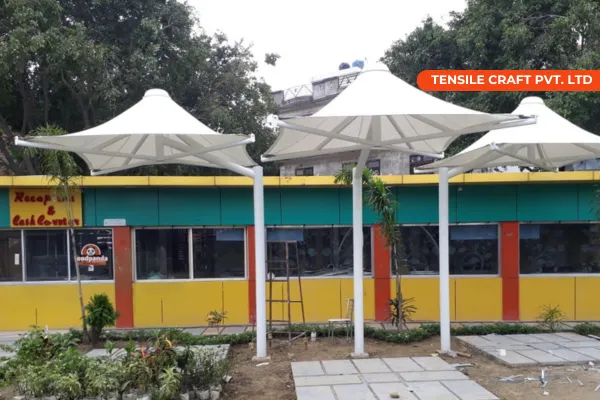
15 Types of Tensile Fabric Structures
Conical, saddle, hypar, barrel vault — all fabric structure forms explained with applications.
Fabric Types
Tensile Structure Cost in India 2026
Per sq.ft. pricing for all structure types — PVC vs PTFE cost impact on total project.
Cost Guide