

Table of Contents
Every tensile fabric structure in the world—from a 3m garden umbrella to a 50,000 seater stadium roof—is a variation of just three fundamental geometric shapes. Understanding these shapes is the key to knowing what type of structure is right for your project.
At Tensile Craft, our design team doesn't just pick a shape because it looks good; we pick it because the geometry solves the structural and functional requirements of the space. Here is the complete taxonomy of tensile forms.
The Golden Rule of Tensile Design: Fabric cannot resist compression or bending—it can only resist tension. Therefore, the fabric surface must have curvature. A flat tensile roof is an engineering impossibility; it will flutter in the wind and collapse under rain. Every valid tensile form uses curvature to create structural stiffness.
1. The Geometry Rule: Anticlastic vs Synclastic
Before diving into types, you must understand the two fundamental curvatures in tensile design:
- Anticlastic (Saddle Curvature): The surface curves UP in one direction and DOWN in the perpendicular direction simultaneously (like a horse saddle or a Pringles chip). This is the most stable form because it resists wind from any direction. Water runs off the two low edges.
- Synclastic (Dome Curvature): The surface curves UP in all directions from the center (like a bowl or a cone). It requires a perimeter ring or masts to prevent it from flattening. Water runs off all edges equally.
Engineering Detail — Why Anticlastic is Superior: When wind pushes down on an anticlastic surface, the fabric in the "down" curve tightens, transferring load to the cables. When wind pushes UP (suction), the fabric in the "up" curve tightens. It resists load in both directions without losing tension. Synclastic forms need heavy perimeter rings to resist flattening from uplift.
2. Type 1: Conical (Cone) Structures
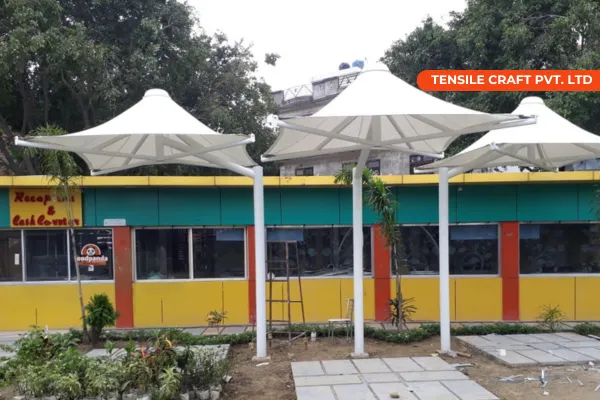
A synclastic form with a single central high point (mast) and a circular or polygonal low perimeter. The fabric slopes downward from the peak like a mountain.
- Geometry: Synclastic.
- Water Runoff: 360° radial runoff to all perimeter edges.
- Best Span: 5m to 30m (single mast). Larger spans require multi-mast conical arrays.
- Applications: The default choice for umbrellas, individual car parking, centerpieces of courtyards, and small auditoriums.
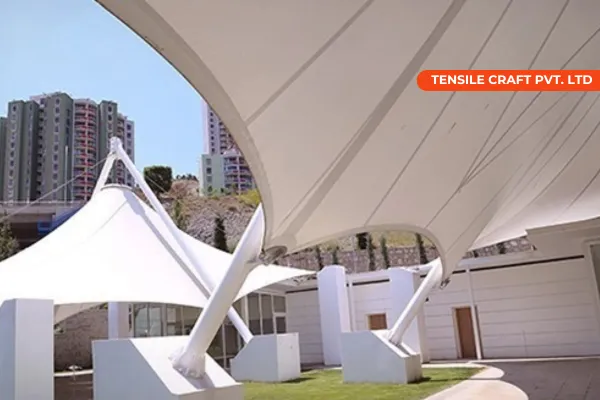
3. Type 2: Hypar (Saddle) Structures
An anticlastic form defined by two high points and two low points, creating a twisted, saddle-like surface. It is the most structurally efficient form in tensile architecture.
- Geometry: Anticlastic.
- Water Runoff: Directed to the two low corners where gutters are installed.
- Best Span: 5m to 25m per module. Easily scaled by connecting multiple hypar modules.
- Applications: Architectural entrance canopies, gazebos, connecting walkways, and premium stadium VIP covers. The go-to choice when visual drama is as important as function.
4. Type 3: Barrel Vault Structures
A series of parallel arches with fabric stretched between them, creating a tunnel-like or half-pipe shape. It is the most efficient way to cover long, rectangular footprints.
- Geometry: Synclastic along the arch span, linear along the length.
- Water Runoff: Directed to the valley gutters running parallel between the arches.
- Best Span: 10m to 50m arch span. Length is virtually unlimited (arches can be repeated indefinitely).
- Applications: Multi-bay car parking, industrial factory roofs, large roof structures, sports halls, and airport terminals.
⚠ Warning — The Arch Thrust Problem: Barrel vaults push outward at the arch bases. If the arches are not tied together underground or anchored to heavy grade beams, they will slowly splay apart, causing the fabric to sag and the structure to collapse.
5. Type 4: Mast & Membrane Arrays
For spans exceeding 30m, single cones or hypars become structurally inefficient. We use arrays of multiple masts connected by a network of fabric panels and boundary cables. This creates a landscape of peaks and valleys.
- Conical Array: Multiple masts with individual cone modules connected by valley cables. Used for stadium roofs and large public squares.
- Wave Array: Masts of alternating heights creating a flowing, wave-like silhouette. Used for landmark architectural projects.
6. Quick Selection Matrix by Application
| Application | Best Type | Why |
|---|---|---|
| 1-4 Car Parking | Conical (Umbrella) | 360° water runoff, lowest cost per bay. |
| 10+ Car Row | Barrel Vault | Maximum coverage per linear meter, continuous gutter. |
| Building Entrance | Hypar (Saddle) | Architectural drama, aerodynamic stability. |
| Garden/Terrace | Hypar Gazebo | Freestanding, 4-column stability, elegant shape. |
| Factory/Mall Roof | Barrel Vault / Conical Array | Large spans, natural daylight, fast installation. |
| Stadium/Auditorium | Dome / Mast Array | Massive column-free spans, dramatic interior volume. |
💰 Hybrid Efficiency: For large projects, we often mix types. For example: a central conical dome over a lobby, flanked by barrel vault wings over office spaces, and hypar canopies at the entrances. This optimizes both structural efficiency and architectural aesthetics.
Not Sure Which Type You Need?
Share your site plan — we will recommend the most efficient tensile geometry for your span and use case.
Get Free Design HelpFrequently Asked Questions
What are the main types of tensile structures?
The three main geometric types are Conical (cone-shaped, single high point), Hypar/Saddle (twisted surface, alternating high/low points), and Barrel Vault (tunnel/arch shape). All other tensile forms are hybrids or arrays of these three primary shapes.
What is the difference between anticlastic and synclastic?
Anticlastic surfaces curve in opposite directions simultaneously (like a saddle/hypar), creating inherent structural stability. Synclastic surfaces curve in the same direction (like a dome or cone), requiring a perimeter ring or radial cables to prevent the fabric from flattening under load.
Which tensile structure type is best for car parking?
Conical (umbrella) structures are best for 1-4 cars due to 360° water runoff. For 10+ cars in a row, Barrel Vault structures are more efficient, maximizing coverage per linear meter while allowing continuous drainage along the valley gutters.
Can tensile structures be flat?
No. Flat tensile structures are structurally impossible. Without curvature, the fabric will flutter in the wind (aeolian vibration) and pool water when it rains, leading to rapid failure. A minimum slope of 15° is mandatory for all tensile forms.
What is a hypar structure?
A hypar (hyperbolic paraboloid) is a tensile structure with two high points and two low points, creating a twisted saddle shape. It is highly structurally efficient because its anticlastic curvature resists wind loads in all directions. It is the preferred choice for architectural entrance canopies.
How far can a tensile structure span without columns?
Conical and Hypar structures typically span 10-30m. Barrel vaults span 20-50m. Tensile domes and Schwedler grid shells can span 50-200m without any internal columns, making them the largest column-free roofing systems in the world.
Related Articles
Continue reading about tensile structures
Tensile Membrane Ultimate Guide
Deep dive into membrane materials, patterning, and welding.
Membranes
Architecture Design Trends
Biomimicry, ETFE, and computational form-finding for modern types.
Architecture