


Table of Contents
- Why Tensile Car Parking is Booming in India
- Design Options for Car Parking Structures
- Cost Breakdown: 2026 Rates
- Which Fabric to Choose?
- Standard Dimensions & Heights
- Installation Process Step-by-Step
- Tensile vs Concrete vs Metal Shed
- Where Tensile Car Parking is Used
- Maintenance Requirements
- Frequently Asked Questions
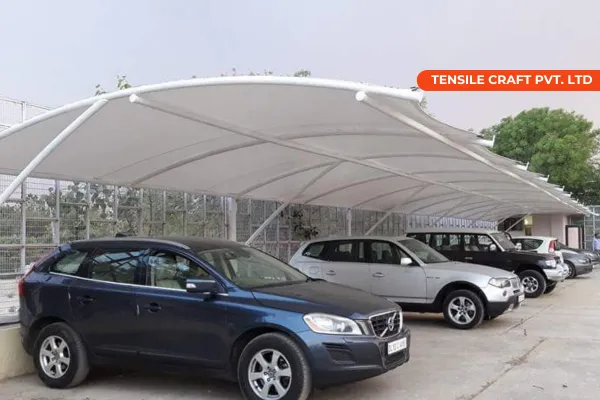
Tensile car parking structures are the single most demanded product in India's tensile industry. In 2026, they account for an estimated 60-65% of all tensile structure installations across the country. From individual homeowners protecting a single car to commercial complexes covering 500+ vehicles, tensile car parking has become the default choice over concrete sheds and metal roofing.
At Tensile Craft Pvt. Ltd., we have installed over 300+ car parking structures across Delhi NCR and India — from residential societies in Dwarka and Rohini to commercial complexes in Gurugram and Noida. This guide consolidates everything we have learned into one comprehensive resource.
Quick Answer: A tensile car parking structure costs ₹250-450 per sq.ft. in India (2026), installs in 3-15 days depending on size, uses PVC or PTFE fabric with 15-30 year lifespan, and provides UV protection, rain shelter, and better ventilation than conventional sheds — all at 40-55% lower cost than concrete.
1. Why Tensile Car Parking is Booming in India
Several factors are driving the rapid adoption of tensile car parking structures in India:
- Vehicle protection is no longer optional. With average car prices exceeding ₹10 lakhs, protecting the paint, interior, and electronics from UV damage and heat has real financial value. A faded dashboard or cracked leather seat can cost ₹15,000-40,000 to repair — far more than the per-car cost of a tensile parking shade.
- RWA and society mandates. Housing societies in Delhi NCR, Bangalore, Pune, and Hyderabad now mandate covered parking. Tensile structures are the fastest way to comply.
- Concrete shed costs have skyrocketed. Cement prices at ₹450-500/bag and steel at ₹65-75/kg make conventional sheds 2x more expensive than 5 years ago. Tensile structure costs have remained relatively stable.
- Speed matters. Developers and RWAs need parking solutions installed in days, not months. Tensile delivers.
- Aesthetic upgrade. Modern residential and commercial projects demand visually appealing architecture. A curved tensile canopy looks far better than a flat concrete slab.
If you are new to tensile structures entirely, start with our What is Tensile Structure? Complete Guide. If you already know the basics and want to understand why they are the best choice, read our 15 Benefits of Tensile Structures in 2026.
2. Design Options for Car Parking Structures
The design of your tensile car parking depends on the number of cars, available space, and aesthetic preference. Here are the four primary designs used in India:
01 Conical (Umbrella) Design
A single central mast with fabric sloping outward to perimeter columns. This is the most popular design for individual and double car parking because water runs off efficiently in all directions, the structure looks clean and modern, and it is the most cost-effective option.
Best for: 1-4 car parking, residential societies, individual villas
Most Popular Lowest Cost02 Saddle (Hypar) Design
Two high points and two low points creating a twisted saddle shape. This design is visually striking and provides excellent structural stability due to its anticlastic curvature. It is commonly used at entrance canopies and premium parking areas.
Best for: 2-6 car parking, hotel driveways, commercial entrances
Premium Look High Stability03 Barrel Vault Design
A series of parallel arches with fabric stretched between them, creating a tunnel-like covered space. This is the preferred design for multi-bay parking where 10-100+ cars need to be covered in a continuous row. It maximizes covered area per linear meter.
Best for: 10+ car parking, commercial complexes, malls, IT parks
Maximum Coverage Scalable04 Wave Form Design
Undulating fabric surface creating a flowing wave pattern between alternating high and low points. This is a premium architectural design chosen for high-end projects where visual impact is the primary requirement.
Best for: Luxury hotels, premium residential towers, architectural landmarks
Architectural Premium3. Cost Breakdown: 2026 Rates
Here is the current pricing for tensile car parking structures in Delhi NCR (prices vary ±10% for other metros, ±15% for Tier-2 cities):
| Configuration | Cars | Area (sq.ft.) | Cost/sq.ft. | Total Cost |
|---|---|---|---|---|
| Single Bay Conical | 1 car | 200 | ₹250-300 | ₹50,000-60,000 |
| Double Bay Conical | 2 cars | 400 | ₹240-290 | ₹96,000-1,16,000 |
| 4-Car Conical | 4 cars | 800 | ₹230-280 | ₹1,84,000-2,24,000 |
| 4-Car Saddle | 4 cars | 800 | ₹280-340 | ₹2,24,000-2,72,000 |
| 10-Car Barrel Vault | 10 cars | 2,000 | ₹300-380 | ₹6,00,000-7,60,000 |
| 20-Car Barrel Vault | 20 cars | 4,000 | ₹280-360 | ₹11,20,000-14,40,000 |
| 50-Car Barrel Vault | 50 cars | 10,000 | ₹260-340 | ₹26,00,000-34,00,000 |
What affects the per sq.ft. rate?
- Design complexity: Conical is cheapest, wave form is 30-40% more expensive
- Fabric choice: Standard PVC is base rate; PVDF top coat adds 10-15%; PTFE adds 60-80%
- Height: Structures above 4.5m need heavier steel, adding 10-15% to cost
- Location: Delhi, Mumbai, Bangalore = standard rates; Tier-2 cities = 10-15% less; remote sites = 15-25% more (transport + installation logistics)
- Foundation conditions: Rocky terrain, high water table, or weak soil increase foundation cost by 20-40%
- Quantity: Orders for 100+ cars get 5-10% bulk discount
For comprehensive pricing across all structure types, see our Tensile Structure Cost in India 2026 guide.
Get Exact Pricing for Your Parking
Share your car count, available space, and location — we will send a detailed quotation within 24 hours.
Get Free Quotation4. Which Fabric to Choose?
The fabric is the most critical component of your tensile car parking structure. For car parking specifically, here is our recommendation based on 300+ installations:
| Fabric | Cost/sq.m. | Lifespan | Colours | Our Recommendation |
|---|---|---|---|---|
| PVC (Standard) | ₹350-450 | 12-15 years | Many | Budget projects |
| PVC + PVDF Top Coat | ₹450-600 | 15-20 years | Many | ⭐ Best for car parking |
| PTFE Fiberglass | ₹800-1,200 | 25-30 years | White | Over-specified for parking |
Why PVC + PVDF is the best choice for car parking:
- The PVDF (Polyvinylidene Fluoride) top coat creates a non-stick surface that resists dirt accumulation and reduces fading — critical for outdoor exposure
- Available in multiple colours — white, blue, green, red, beige, grey — allowing you to match building aesthetics
- UPF 50+ UV protection as standard — blocks 98%+ harmful radiation
- The 15-20 year lifespan aligns well with the typical RWA redevelopment cycle
- At end of life, only the fabric needs replacement (25-35% of original cost) — steel structure continues serving
PTFE fabric, while superior in lifespan and self-cleaning, is over-specified for car parking. It costs 2x more and comes only in white. We recommend PTFE for membrane structures at airports, stadiums, and premium architectural projects. For detailed fabric comparison, read PTFE vs PVC: Which is Better?
5. Standard Dimensions & Heights
Based on Indian vehicle sizes and parking standards, here are the dimensions we follow at Tensile Craft:
| Parameter | Standard Car | SUV / Large | Commercial |
|---|---|---|---|
| Bay Width | 2.5m (8.2 ft) | 3.0m (10 ft) | 3.0m (10 ft) |
| Bay Depth | 5.0m (16.4 ft) | 5.5m (18 ft) | 5.5m (18 ft) |
| Clear Height (min) | 2.5m (8.2 ft) | 3.0m (10 ft) | 2.7m (8.9 ft) |
| Column Spacing | 5.0-6.0m | 5.0-6.0m | 6.0-8.0m |
| Area per Car | 12.5 sq.m (135 sq.ft.) | 16.5 sq.m (178 sq.ft.) | 16.5 sq.m (178 sq.ft.) |
Height considerations: The minimum clear height is measured from the finished ground level to the lowest point of the fabric membrane. For conical designs, the lowest point is at the perimeter; for barrel vault designs, it is at the valley between arches. Always confirm that the lowest point meets the minimum height requirement for your vehicle type.
6. Installation Process Step-by-Step
Here is exactly how a tensile car parking structure is installed — this is the process we follow at Tensile Craft for every project:
-
Site Survey & Measurement
Our team visits your site to measure available space, check soil conditions, identify underground utilities, and assess access for installation equipment. This takes 2-4 hours.
-
Design & Engineering Drawing
Based on site data, we prepare structural drawings including foundation plan, steel fabrication drawings, fabric patterning, and 3D renderings for your approval. Timeline: 2-4 days.
-
Foundation Work
Concrete footings are cast at each column location. For standard car parking (2.5-3.0m height), footings are typically 1.0m x 1.0m x 0.8m depth. For softer soil, depth increases. Curing: 3-7 days. Note: Foundation work is done by your civil contractor or arranged by us separately.
-
Steel Fabrication (Off-site)
Simultaneously with foundation curing, masts, arches, base plates, and connection hardware are fabricated at our workshop using CNC machines. Galvanization and powder coating are done before dispatch. Timeline: 5-10 days.
-
Steel Erection
Steel columns are anchored to foundations using anchor bolts. Masts are erected using a mobile crane or winch system. All connections are torque-checked to specified values as per IS 800 standards. Timeline: 1-3 days.
-
Fabric Installation & Tensioning
Pre-cut and welded fabric panels are lifted onto the steel framework, clamped at all connection points, and then tensioned using turnbuckles to the specified pre-tension value (typically 1-3 kN/m for PVC car parking fabric). Timeline: 1-2 days.
-
Final Inspection & Handover
All connections, tension levels, and dimensions are checked against the approved drawings. Photos and a completion report are provided. The structure is ready for immediate use. Timeline: 1 day.
Total Timeline: Foundation curing (3-7 days) + Steel fabrication (5-10 days, parallel) + Erection & tensioning (2-5 days) = 7-15 working days from foundation readiness for standard car parking up to 20 cars.
7. Tensile vs Concrete vs Metal Shed
This is the comparison every client asks for. Here is a direct head-to-head for a 10-car parking structure (2,000 sq.ft.) in Delhi NCR:
| Parameter | Tensile Structure | Concrete Shed | Metal Sheet Shed |
|---|---|---|---|
| Total Cost | ₹6-7.6 lakhs | ₹12-16 lakhs | ₹8-11 lakhs |
| Cost/sq.ft. | ₹300-380 | ₹600-800 | ₹400-550 |
| Installation Time | 7-12 days | 8-12 weeks | 3-5 weeks |
| Weight | 2-5 ton | 80-120 ton | 8-15 ton |
| UV Protection | UPF 50+ | None (unless painted) | None |
| Natural Light | 8-15% | None | None |
| Ventilation | Excellent | Poor (enclosed) | Moderate |
| Rain Noise | Minimal | Minimal | Very loud (drumming) |
| Water Leakage | Rare | Common over time | Common at joints |
| Annual Maintenance | ₹3,000-6,000 | ₹15,000-30,000 | ₹8,000-15,000 |
| Structure Lifespan | 15-20 years (fabric) | 40-50 years | 20-30 years |
| Replaceable Roof | Yes (25-35% cost) | No | Partial |
| Aesthetic Appeal | Excellent | Moderate | Poor-Mod |
The verdict is clear: for car parking specifically, tensile structures win on cost, speed, UV protection, ventilation, and aesthetics. Concrete wins only on absolute structural lifespan — but even that advantage narrows when you factor in that tensile fabric can be replaced independently at 25-35% of original cost, effectively giving you a second structure life.
8. Where Tensile Car Parking is Used
Tensile car parking structures are installed across every sector in India:
- Residential Societies (RWAs): The largest segment. Individual, double, and row parking for apartments and group housing. Accounts for ~45% of installations. Common in Delhi NCR, Bangalore, Pune, Hyderabad, Chennai.
- Individual Villas & Farmhouses: Single or double car parking at independent homes. Popular in Delhi farmhouses, Goa villas, Lonavala bungalows.
- Commercial Complexes & IT Parks: Multi-bay barrel vault parking for 50-500+ cars. Found at Gurugram IT corridors, Hyderabad HITEC City, Pune Hinjewadi, Bangalore Whitefield.
- Malls & Retail: Covered parking at shopping centres. Often combined with entrance canopies for a unified architectural statement.
- Hospitals & Hotels: Valet and visitor parking with premium aesthetic designs. Hotels often choose saddle or wave form designs for visual impact.
- Industrial Facilities: Employee and visitor parking at factories and warehouses. Prioritizes cost and speed over aesthetics.
- Educational Institutions: Staff and student parking at schools, colleges, and universities. Often integrated with walkway coverings connecting parking to buildings.
- Government Buildings: Parking for courts, municipal offices, and public facilities. Must comply with government procurement norms and IS standards.
9. Maintenance Requirements
One of the biggest advantages of tensile car parking is low maintenance. Here is the annual maintenance schedule:
| Task | Frequency | Cost | Details |
|---|---|---|---|
| Fabric Cleaning | 2 times/year | ₹1,000-2,000 | Mild soap water with soft brush. No pressure washing. |
| Steel Inspection | Once/year | ₹500-1,000 | Check for galvanization damage, loose bolts, corrosion at base. |
| Tension Check | Once/year | ₹500-1,000 | Verify fabric tension with tension meter. Adjust turnbuckles if slack. |
| Cable Inspection | Once/year | ₹500 | Check for fraying, broken strands, thimble damage. |
| Drainage Check | Before monsoon | Free | Ensure no debris blocking water runoff paths at fabric edges. |
| Annual Total (4-car) | - | ₹2,500-5,000 | Compare: concrete shed = ₹15,000-25,000/year |
For the complete maintenance guide with DIY tips and professional service recommendations, read our 20 Expert Maintenance Tips for Tensile Structures.
Ready to Install Your Car Parking Structure?
Tensile Craft offers end-to-end service — design, engineering, fabrication, installation, and maintenance support.
Call: +91-9217718546Frequently Asked Questions
What is the cost of tensile car parking in India?
Tensile car parking structures cost ₹250-450 per sq.ft. in India (2026 rates). Single-bay conical designs cost ₹250-320/sq.ft., double-bay saddle designs cost ₹300-380/sq.ft., and multi-bay barrel vault designs cost ₹350-450/sq.ft. The total cost for a standard 4-car parking (800 sq.ft.) is approximately ₹1,84,000-2,24,000.
Which design is best for tensile car parking?
Conical (umbrella) design is best for single and double car parking due to excellent water runoff and cost efficiency. For multi-bay parking (10+ cars), barrel vault design is preferred for uniform coverage. Saddle (hypar) design is ideal for architectural entrances and premium installations.
How long does tensile car parking installation take?
For a standard 4-car parking, installation takes 3-5 days after foundation readiness. For 20-50 car parking, it takes 7-15 days. For large commercial installations (100+ cars), it takes 15-30 days. Foundation work adds 3-7 additional days for concrete curing.
Is tensile car parking better than concrete shed?
Yes. Tensile car parking is 40-55% cheaper than concrete (₹250-450/sq.ft. vs ₹500-800/sq.ft.), installs 5x faster (3-15 days vs 2-3 months), is 90% lighter, provides better ventilation, allows natural light, and can be replaced without demolition. Concrete sheds last longer structurally but have higher maintenance costs due to waterproofing needs.
What is the minimum height for tensile car parking?
The minimum clear height for car parking under a tensile structure is 2.5 meters (8.2 feet) from ground level to the lowest point of the fabric. For SUVs and larger vehicles, 3.0 meters (10 feet) is recommended. For commercial multi-level parking, 2.7 meters per level is standard.
Which fabric is best for car parking tensile structure?
PVC-coated polyester with PVDF top coat is the best choice for car parking in India. It costs ₹450-600/sq.m., lasts 15-20 years, is available in multiple colours, and provides UPF 50+ UV protection. PTFE fabric is a premium option at ₹800-1200/sq.m. with 25-30 year life but is generally over-specified for standard parking applications.
Can tensile car parking withstand heavy rain and wind?
Yes. Structures are designed as per IS 875 Part 3 for wind loads (up to 120-150 km/h depending on location). Fabric slopes of 15-25 degrees ensure rapid rainwater runoff. Pre-tension prevents sagging and water ponding. At Tensile Craft, we have structures in Delhi NCR that have handled monsoons for 10+ years without any water accumulation issues.
Does tensile car parking reduce car interior temperature?
Yes. Under a tensile car parking shade, the ambient temperature is 10-15°C lower than open sun exposure. The dashboard and steering wheel surface temperature is reduced by 25-35°C. This means the AC cools the car faster, reducing fuel/electricity consumption and extending the life of dashboard plastics and leather seats.
Related Articles
Continue reading more about tensile structures
What is Tensile Structure? Complete Guide
Learn the fundamentals — definition, working principle, components, types, and materials.
Basics
Tensile Structure Cost in India 2026
Detailed per sq.ft. pricing for every type — cost factors, comparison tables, and tips.
Cost Guide
Tensile Car Parking Guide
Delhi-specific pricing, RWA requirements, and local installation considerations.
Delhi