


Table of Contents
In India, when people hear "dome structure," three names come to mind: Howrah Station's new roof in Kolkata, Eden Gardens cricket stadium canopy, and the JLN Stadium tensile membrane roof in Delhi. These are all tensile dome structures — and they represent the highest form of tensile engineering.
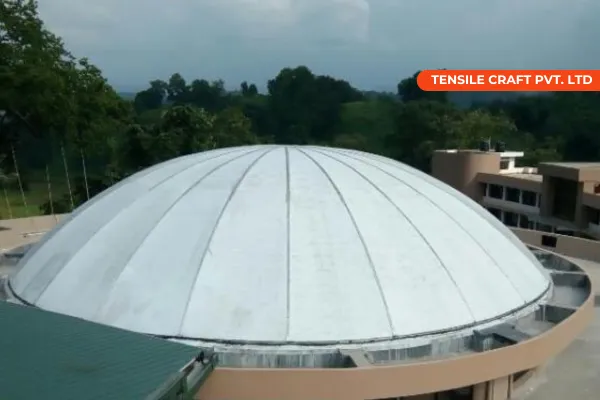
A tensile dome is fundamentally different from other tensile structure forms. While most tensile structures use saddle (hypar) or conical shapes, a dome uses radial symmetry — fabric tension radiating outward from a central point to a perimeter ring. This creates a self-supporting, column-free roof that can span enormous areas with remarkable efficiency.
At Tensile Craft, dome structures represent our most technically complex projects. They require precise structural engineering, CNC-patterned fabric panels, and carefully sequenced installation. This article explains how they work, their components, types, costs, and real Indian case studies.
Key Engineering Fact: A tensile dome works through a pure force triangle — the fabric carries only tension, the perimeter ring carries only compression, and the cables transfer forces between them. No bending, no shear — just tension and compression. This is why domes can span 100+ meters without a single internal column, something impossible with conventional construction at reasonable cost.
What is a Tensile Dome?
A tensile dome is a self-supporting roof system consisting of three interacting structural systems:
The Membrane (The Roof Surface)
The fabric membrane is cut into wedge-shaped panels (called gores) that are tensioned between radial cables. Each gore is wider at the perimeter and narrows to a point at the central mast. The fabric carries only pure tension — it cannot carry compression or bending. Standard materials are PVC-coated polyester for standard projects and PTFE-coated fiberglass for landmark projects.
The Mast (The Anchor)
A central vertical steel mast (or multiple masts for large domes) anchors the peak of the membrane. The mast resists the downward pull from the tensioned fabric. For a single-mast dome, the mast takes all the downward load. For large domes (50m+ diameter), 4-12 masts are typical, connected by a steel hub at the crown.
The Compression Ring (The Key Differentiator)
A circular steel ring positioned at the dome perimeter. This is the defining component — it is the only element in the system that carries compression. The inward radial pull from the fabric and cables tries to squeeze the ring, and the ring resists through pure axial compression. It is typically a MS pipe (IS 1239 Grade E250, 200-400mm OD, 8-16mm thick) welded into a continuous circle. The ring must be perfectly circular — even 10mm out-of-roundness causes uneven stress distribution.
Engineering Insight: The compression ring is the reason a dome is structurally efficient. In a conventional building, both the roof AND walls carry compression. In a dome, the roof carries only tension, the ring carries only compression, and the steel cables connect the two. This separation allows each component to be optimized for its primary force — tension for fabric, compression for the ring — resulting in dramatic material savings compared to conventional construction.
The Cables (The Connectors)
Two types of cables work in a dome:
- Radial cables: Run straight from mast tops to the compression ring, following the seam lines between fabric gores. These transfer the fabric's radial tension to the ring. Typically 12-48 radial cables are used, evenly spaced around the circumference.
- Circumferential cables: Run horizontally around the top of the compression ring (or at the fabric edge) to resist the horizontal inward component of radial forces. Used in larger domes where the ring alone cannot handle the circumferential load.
How Does a Tensile Dome Work Structurally?
The structural logic is elegant in its simplicity — it is a force triangle:
- Fabric = Tension only. The membrane is pulled tight between radial cables, like a drum skin. It carries no bending or compression. When wind pushes on the dome, the pre-tension prevents fluttering.
- Ring = Compression only. The fabric and cables push inward (radially) on the ring. The ring acts as a giant hoop under compression. It needs to be sized for the total inward radial force from all cables combined.
- Cables = Transfer only. Cables carry the fabric's load to the ring and distribute it around the perimeter. Each cable carries a portion of the total radial force. The ring then transfers this force uniformly as axial compression.
The Force Flow (Detailed)
When external loads act on the dome, the force path is:
External load (wind/rain/snow) → Fabric membrane distributes load across surface → Radial cables collect load and carry it to ring → Compression ring resists inward radial push → Mast takes the total downward reaction → Foundation anchors the mast to the ground.
The Double Curvature Requirement
Like all tensile structures, a dome must have double curvature to be stable. In a dome, this is automatically achieved — the radial curvature from mast to ring plus the circumferential curvature along the ring creates double curvature at every point on the surface. This means the membrane cannot flutter or wrinkle under wind — a critical advantage for large-span roofs.
Pre-Tension Values
The pre-tension in the fabric for a dome is typically 1-3 kN/m (100-300 kg/m) in the radial direction. This is higher than the 1-2 kN/m typical for saddle structures because the dome's curvature demands higher tension to maintain shape stability. Higher pre-tension means slightly thicker fabric (900-1100 gsm instead of 800 gsm for hypar), but the engineering benefits justify the cost increase.
Design Standards
- IS 800:2007 — Steel design for masts, cables, and connection hardware
- IS 875 Part 3 — Wind load calculation for the membrane surface
- IS 1239 — Steel pipes for the compression ring
- IS 2062 — Structural steel grade (E250 or E350 for higher loads)
- ASCE 17-96 — American standard for tensile membrane structures (referenced when IS codes don't cover specific membrane details)
- DIN 4102 Part 1 — Fire rating for PVC fabric (B1) and PTFE fabric (A)
- DIN 16726-1 — PVC fabric for textile architectural structures (chlorine class ratings)
Need a Dome Structure Designed?
Share your project details — span, capacity, location — and we will provide structural design, 3D visualisation, and cost estimate for your dome project.
Get Free ConsultationThree Essential Components
A. The Fabric Membrane
Dome fabric is cut into wedge-shaped gores — wider at the ring, pointed at the mast. Each gore is CNC-cut from flat fabric and then welded together using high-frequency welding. The number of gores depends on dome diameter — a 16m dome typically uses 16-24 gores, a 50m dome may use 48-64 gores, and large stadium domes can have 100+ gores.
The seam lines between gores run radially from mast to ring. These seams are high-frequency welded under factory conditions and must achieve minimum 80% of the base fabric tensile strength as per fabric manufacturer specifications.
B. The Compression Ring
The ring is fabricated from MS pipe sections cut to precise radius, welded into a circle, galvanized, and powder-coated. Key specifications for a 35m diameter dome:
- Pipe size: 219.1mm OD × 12mm thick (IS 1239 Grade E250)
- Diameter: 35m (ring centerline)
- Wall thickness: 12mm
- Weight: Approximately 1,200-1,500 kg for the complete ring
- Galvanizing: IS 2629 hot-dip galvanized (65-85 micron zinc coating)
- Finish: Polyester powder coating (60-80 micron) for appearance and additional protection
C. The Mast and Cables
Masts are fabricated from MS pipes (typically 88.9mm to 219.1mm OD). For a single-mast dome, the mast is a single vertical column with a hub at the top where radial cables connect. For multi-mast domes, 4-12 masts are arranged symmetrically around the ring, each carrying an equal share of the radial load.
Stainless steel cables (SS 316) are used for the radial and circumferential cables because they are not galvanized (galvanizing is not recommended for high-stress cable applications) and provide excellent corrosion resistance in the pool environment. Cable diameters range from 12-30mm depending on dome size and design load.
5 Types of Tensile Domes
1. Radial Cone (Most Common)
A single central mast with fabric radiating outward to a perimeter ring, creating a classic cone shape. This is the default choice for 80% of tensile domes in India. Simple, efficient, and the easiest to fabricate because all gores are identical.
Where used: Tensile dome structures for resorts, residential complexes, exhibition halls, and mid-size auditoriums. Most commonly seen in tensile architecture across India.
2. Multi-Mast Radial Dome
Multiple masts (4-12) arranged symmetrically within the ring, each supporting a sector of the dome. The fabric panels between masts are slightly different shapes (non-identical gores) because the perimeter arc between masts is not circular. Slightly more complex to fabricate but distributes loads better for very large domes.
Where used: Stadiums (50m+ diameter), convention centres, large auditoriums, exhibition halls, airport terminals. Used in large-span roof structures.
3. Schwedler Dome
Invented by Jörg Schwedler, this system uses a network of straight struts (not cables) arranged in a geodesic pattern. A fabric membrane is draped over the strut network and tensioned. No compression ring is needed — the strut network handles compression. This allows domes with 50-200m+ diameter without the limitation of compression ring manufacturing.
Where used: Very large stadiums, expo pavilions, and landmark architectural projects where conventional ring fabrication is impractical. Rare in India but globally recognized as the most advanced dome technology.
4. Parabolic Dome
A parabolic arch profile where the height varies around the perimeter — higher at entrances, lower at mid-sides. This creates dramatic architectural entrances with a high entrance arch that naturally draws people in. The varying height creates visual drama and makes the structure feel welcoming.
Where used: Building entrances, airport arrival halls, mall entrances, museum foyers. Often combined with tensile entrance canopies as an extended entrance design.
5. Conical + Barrel Vault Hybrid
A combination design where the central portion is conical but the edges transition into barrel vault segments. This provides the visual impact of a dome at the center with the practical advantages of barrel vaults along the sides. Often used when the dome needs to extend beyond the main ring into covered walkway areas.
Where used: Multi-use complexes where the dome structure extends into walkway structures, or when the pool area needs both a dome and covered walkway from a single structure.
Real Indian Dome Projects
India has some of the world's most recognized tensile dome structures. These are not conceptual designs — they are built, installed, and performing in real Indian conditions:
Howrah Railway Station Roof Renovation
The iconic Howrah Station renovation used a PTFE membrane dome of approximately 180m x 180m covering the main station area. The design features a series of modular conical modules arranged in a grid pattern. The PTFE fabric was chosen for self-cleaning, low maintenance, and long life in Kolkata's high-humidity, monsoon-heavy climate. The project demonstrated that tensile domes can replace conventional roofing even for India's busiest railway station with 500,000+ daily footfall.
JLN Stadium, New Delhi
The Jawaharlal Nehru Stadium, renovated for the 2010 Commonwealth Games, features a tensile membrane dome-roof system covering the seating areas. The multi-mast radial dome was chosen to provide shade for spectators while allowing natural ventilation for airflow. The structure demonstrated that tensile membrane can handle 100,000+ spectators plus stage lighting, sound equipment, and Delhi's extreme summer heat simultaneously.
Eden Gardens Cricket Stadium, Kolkata
Eden Gardens has used various tensile covers over the stands. The current system includes conical tensile umbrellas over seating areas, providing shade for spectators during matches while maintaining the open-air feel that Eden is famous for. The lightweight design meant minimal structural modification to the heritage-grade structure.
Salt Lake Stadium, Kolkata
Salt Lake Stadium features a large radial dome system covering the spectator areas. This is one of India's largest multi-mast dome installations and demonstrates that Indian manufacturers can handle the engineering complexity of large-scale dome projects with 24+ masts and 5,000+ sq.m. of fabric.
What these projects prove: Tensile domes are not experimental in India — they are proven, tested, and performing in real Indian conditions. The engineering methods used for Howrah, JLN, Eden, and Salt Lake are the same we use for every dome project at Tensile Craft.
Applications by Sector
- Stadiums & Sports Complexes: Cricket stadiums, football grounds, indoor stadiums, multi-sport complexes, shooting ranges. Domes provide column-free coverage, natural light, and dramatic architecture that enhances the venue's visual identity.
- Exhibition & Convention Centres: Exhibition halls, trade centres, expo pavilions, convention centres. Domes allow massive column-free spaces for flexible booth layouts, rapid installation, and striking exteriors that attract visitors.
- Architectural Landmarks: Government buildings, museums, airports, metro stations, cultural centres. Domes create instantly recognizable landmarks that become city icons.
- Auditoriums & Theatres: Performance spaces where acoustics, natural light, and column-free sightlines are essential. Domes provide all three while looking spectacular.
- Temples & Religious Structures: Many modern temples, mosques, and gurudwaras are using tensile domes for their main prayer halls because traditional stone/concrete domes are expensive and slow to build.
- Industrial Facilities: Factory sheds, warehouses, logistics hubs, and process plant covers where large clear spans are needed without columns.
Cost for Different Dome Sizes
| Diameter | Approx. Area | Recommended Type | Total Cost Range | Cost/sq.ft. |
|---|---|---|---|---|
| 10m (33 ft) | 800-1,100 sq.ft. | Radial Cone (single mast) | ₹1,60,000 - ₹3,30,000 | ₹200 - ₹300 |
| 16m (52 ft) | 2,000-2,700 sq.ft. | Radial Cone (single mast) | ₹3,50,000 - ₹7,50,000 | ₹175 - ₹275 |
| 25m (82 ft) | 5,400-6,500 sq.ft. | Radial Cone (single or 2-mast) | ₹7,50,000 - ₹16,50,000 | ₹140 - ₹250 |
| 35m (115 ft) | 9,700-13,000 sq.ft. | Multi-mast Radial (4 masts) | ₹13,00,000 - ₹28,50,000 | ₹135 - ₹220 |
| 50m (164 ft) | 19,000-24,000 sq.ft. | Multi-mast Radial (6-8 masts) | ₹27,00,000 - ₹60,00,000 | ₹130 - ₹250 |
| 80m (262 ft) | 48,000-60,000 sq.ft. | Multi-mast (8-12 masts) | ₹65,00,000 - ₹1,40,00,000 | ₹135 - ₹230 |
| 100m+ (328+ ft) | 86,000+ sq.ft. | Schwedler or Multi-mast | ₹1,20,00,000+ | ₹130 - ₹200+ |
Why per sq.ft. cost decreases with size: The fixed costs — design engineering, mobilization, fabrication setup — remain roughly constant regardless of dome size. A 10m dome and a 50m dome require similar design effort, so the overhead per sq.ft. is much lower for the larger dome. For very large domes, per sq.ft. rate can drop to ₹130-150.
For the complete pricing methodology, see our Tensile Structure Cost in India 2026 guide.
Tensile Dome vs Conventional Roof
| Parameter | Tensile Dome | Conventional Roof (RCC/Steel Truss) |
|---|---|---|
| Span without columns | 100+ meters | 25-30 meters (beyond this, trusses become impractical) |
| Weight | 1-5 kg/sq.m. | 25-100 kg/sq.m. |
| Installation time | 10-20 days (membrane only) | 3-6 months (full roofing system) |
| Foundation | Small isolated footings for masts only | Heavy continuous foundations + columns |
| Natural daylight | 10-25% light transmission | Requires skylights (extra cost) |
| Steel consumption | 8-15 kg/sq.m. (cables + masts only) | 30-80 kg/sq.m. (trusses + purlins + columns) |
| Relocatable | Yes — dismantling and re-erectable | No — permanent structure |
| Cost for 6,500 sq.ft. (25m dome) | ₹7,50,000 - ₹16,50,000 | ₹20,00,000 - ₹40,00,000+ |
| Cost for 24,000 sq.ft. (50m dome) | ₹27,00,000 - ₹60,00,000 | ₹80,00,000 - ₹1,80,00,000+ |
For the 20-year lifecycle cost comparison including maintenance and fabric replacement, tensile domes cost 60-80% less than conventional roofs. The savings increase with dome size because conventional roofs become exponentially more expensive as span increases, while tensile dome costs scale linearly with area.
Get a Dome Structure Cost Estimate
Share your dome diameter, height, location, and application — we will provide engineering design, 3D visualisation, and exact cost estimate.
Get Free EstimateFrequently Asked Questions
What is a tensile dome structure?
A tensile dome structure is a self-supporting roof system where a fabric membrane is tensioned over a central mast and perimeter compression ring using radial cables, creating a column-free dome-shaped roof. It works through pure tension (fabric), compression (ring), and load transfer (cables). It can span 100+ meters without internal columns and is used for stadiums, exhibition halls, temples, and architectural landmarks.
What is a compression ring in tensile dome?
The compression ring is a circular steel pipe ring positioned at the perimeter of a tensile dome. It receives inward radial forces from the tensioned fabric and cables and resists them through pure axial compression (no bending). It is typically made from MS pipe 200-400mm OD, 8-16mm thick, hot-dip galvanized per IS 2629, and powder coated. It is the defining element that differentiates a dome from other tensile forms. The ring must be perfectly circular and sized for the total radial load. IS 1239 Grade E250 steel is the standard specification.
What is the cost of tensile dome in India?
Tensile dome structures in India cost ₹130-250 per sq.ft. for small residential domes (10-15m diameter), ₹135-250/sq.ft. for mid-size domes (25-35m), and ₹130-230/sq.ft. for large domes (50m+ diameter). A standard 25m (82 ft) dome (approx. 6,500 sq.ft. coverage) costs ₹7.5-16.5 lakhs. Stadium-scale domes (80m+, 20,000+ sq.ft.) cost ₹65 lakhs - ₹1.4+ crores depending on complexity.
How does a tensile dome work structurally?
A tensile dome works through a force triangle: the fabric carries only tension, the compression ring carries only compression, and the cables transfer forces between them. The pre-tension in the fabric converts it into a rigid structural shell. Radial cables connect masts to the ring carrying the fabric's load to the ring. The ring resists the inward radial push through pure axial compression. This tension-compression-cable triangle creates a stable structure with no internal supports that can span 100+ meters without columns.
Can tensile dome withstand Indian wind and monsoon?
Yes. Tensile domes are specifically engineered as per IS 875 Part 3 for wind loads (up to 150-200 km/h for major structures). The curved spherical shape deflects wind smoothly with minimal drag coefficient (0.3-0.5) versus flat roofs (1.2+ drag coefficient). The double curvature prevents flutter. Indian domes at Howrah Station, JLN Stadium, Eden Gardens, and Salt Lake Stadium have withstood decades of Indian monsoons and cyclonic winds.
Is tensile dome fire resistant?
Yes. PVC fabric provides B1 (self-extinguishing) fire rating and PTFE provides A (non-combustible) rating. Both meet Indian fire codes. The open-air nature of dome structures allows smoke to escape upward and heat to dissipate rapidly, which is why fire safety codes favour tensile membranes for public buildings. For high-fire-risk public assembly buildings, PTFE is the standard choice.
Related Articles
Continue reading more about tensile structures
What is Tensile Structure? Complete Guide
Understand what tensile structures are, how they work, components, types, and why they are the future of architecture in India.
Basics
Tensile Structure Cost in India 2026
Per sq.ft. pricing for all structure types — with dome-specific cost analysis and money-saving strategies.
Cost Guide
15 Types of Tensile Fabric Structures Explained
Conical, saddle, hypar, barrel vault — all fabric structure forms explained with real Indian applications and use cases.
Fabric Types