

Table of Contents
When architects need to cover massive spaces—stadiums, airport terminals, factory floors—without cluttering the floor with columns, the tensile roof structure is the definitive solution. While domes use radial symmetry, tensile roofs typically use linear or modular systems (barrel vaults, hypar arrays) to cover rectangular footprints efficiently.
At Tensile Craft, we engineer tensile roofs that span 20m to 100m+ without internal supports. The key is understanding that a tensile roof is not just a waterproof skin—it is a structural shell carrying pre-tension, wind loads, and rain loads back to the perimeter framework.
Key Engineering Fact: The primary advantage of a tensile roof over conventional steel truss roofs is double curvature. A flat metal sheet flutters and fails in wind. A tensile roof's anticlastic curvature (curving in two opposite directions) creates geometric stiffness, allowing the fabric to resist wind loads purely through tension, reducing steel consumption by 70-80%.
1. What Defines a Tensile Roof Structure?
A tensile roof consists of fabric panels tensioned between a series of high points (masts or arches) and low points (gutters or edge cables). It is designed using form-finding software to ensure every square inch of the fabric is in pure tension under all load combinations (dead, wind, rain, snow).
- Conical Roofs: Multiple masts arranged in a grid, each supporting a valley of fabric. Ideal for irregular footprints.
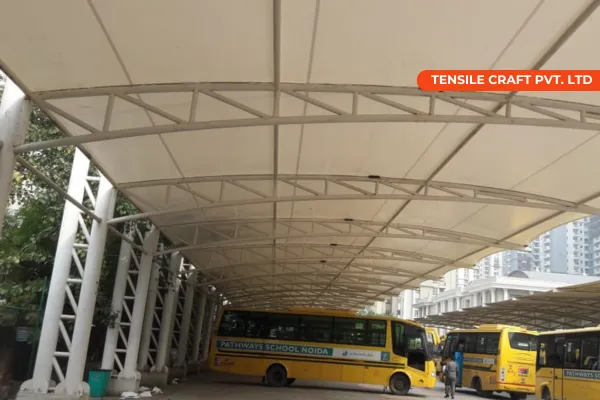
- Barrel Vault Roofs: Parallel arches supporting a continuous tunnel-like fabric. The most efficient for rectangular footprints (malls, factories, walkways).
- Wave Roofs: Alternating high and low masts creating a flowing wave pattern. Purely architectural, used for landmark projects.
2. Barrel Vault Engineering: The Arch Thrust Problem
The barrel vault is the most common tensile roof form, but it introduces a massive structural challenge: horizontal arch thrust.
When fabric is stretched over an arch, the tension pulls the arch outward. If the arches are not restrained, they will slowly splay apart, causing the fabric to sag and the structure to collapse.
Engineering Detail — Resisting Arch Thrust: For a 25m span barrel vault, the outward horizontal thrust at each arch base can be 20-30 kN. We resist this using one of two methods: (1) Tie-back cables connecting the base of opposing arches underground, or (2) Heavy concrete grade beams connecting the arch foundations. Without these tie-backs, the structure will fail.
3. Daylighting & Energy Savings
One of the most overlooked benefits of tensile roofing is free daylighting. Standard PVC fabric allows 10-15% light transmission, and PTFE allows up to 25%.
- Standard Metal Roof: 0% light. Requires 100% artificial lighting during the day.
- Tensile PVC Roof: 10-15% light transmission provides 500-800 lux of diffused, shadow-free light at floor level—enough for general industrial work and retail spaces.
💰 Energy Savings Calculation: For a 50,000 sq.ft. factory roof, replacing metal sheeting with PVC tensile fabric saves approximately 150-200 kW of lighting load during daytime shifts. At ₹8/kWh, this saves ₹4-5 lakhs annually in electricity bills, paying back the fabric premium in 3-4 years.
4. Tensile Roof vs Metal Sheet Roof
| Parameter | Tensile Fabric Roof | Metal Sheet Roof (Trapezoidal) |
|---|---|---|
| Max Span Without Columns | 100+ meters (with masts/cables) | 20-25 meters (beyond this, trusses are massive) |
| Steel Consumption | 8-15 kg/sq.m. | 35-80 kg/sq.m. (purlins + trusses + columns) |
| Daylighting | 10-25% transmission (free daylight) | 0% (requires artificial lighting) |
| Rain Noise | Minimal (fabric absorbs sound) | Extremely loud (drumming effect) |
| Water Leakage | Rare (continuous membrane, no joints) | Common (overlapping sheets, screwed joints fail) |
| Installation Speed | 10-30 days | 45-90 days |
5. Cost by Span & Area (2026)
| Roof Area | Recommended Type | Total Cost Range | Cost/sq.ft. |
|---|---|---|---|
| 1,000 sq.ft. (Walkway) | Barrel Vault (3 arches) | ₹2,50,000 - ₹4,00,000 | ₹250 - ₹400 |
| 5,000 sq.ft. (Factory) | Barrel Vault (8 arches) | ₹10,00,000 - ₹16,00,000 | ₹200 - ₹320 |
| 20,000 sq.ft. (Mall) | Conical Mast Array | ₹36,00,000 - ₹55,00,000 | ₹180 - ₹275 |
For complete pricing methodology, visit our Tensile Structure Cost India 2026 guide.
Get a Large Span Roof Quote
Share your building footprint and use case — we will engineer the most efficient tensile roof system.
Get Free EstimateFrequently Asked Questions
What is a tensile roof structure?
A tensile roof structure is a large-span roofing system using PVC or PTFE fabric tensioned over a steel framework (arches, masts, or portals). It provides column-free coverage for stadiums, malls, and industrial facilities, spanning up to 100+ meters without internal supports.
How much does a tensile roof cost in India?
A tensile roof costs ₹200-450 per sq.ft. in India. A small 500 sq.ft. roof costs ₹1-2 lakhs. Large commercial roofs (10,000+ sq.ft.) cost ₹30-50 lakhs. PTFE roofs cost 60-80% more than PVC but last 25-30 years compared to 15-20 years for PVC.
Are tensile roof structures leakproof?
Yes. Properly engineered tensile roofs are 100% leakproof because the fabric is continuous (no joints like metal sheets) and the minimum 15° slope ensures rapid water runoff. Leaks only occur at poorly sealed mast penetration points or if the fabric sags and causes water pooling.
What is the lifespan of a tensile roof?
PVC tensile roofs last 15-20 years. PTFE tensile roofs last 25-30 years. The steel framework lasts 40-50 years. At the end of the fabric's life, only the membrane needs replacement (25-35% of the original cost), while the steel structure remains intact.
Does a tensile roof provide natural daylight?
Yes. PVC fabric allows 10-15% light transmission, and PTFE allows up to 25%. This provides 500-800 lux of natural diffused daylight, eliminating the need for artificial lighting during the day and reducing electricity costs by 30-40% in large commercial spaces.
Can tensile roofs withstand heavy rainfall and snow?
Yes. Tensile roofs are engineered with a minimum 15° slope for rapid rain runoff. For snow loads (e.g., Himalayan regions), we increase pre-tension values and specify steeper slopes (30°+) to prevent snow accumulation, following IS 875 Part 4 guidelines.
Related Articles
Continue reading about tensile structures
Polycarbonate Sheet Structure Guide
Rigid roofing alternative to fabric for high-impact applications.
Polycarbonate