

Table of Contents
While tensile fabric roofs offer sweeping curves, polycarbonate sheet structures provide the rigidity and hard-surface durability of glass at 1/6th the weight and 250x the impact strength. They are the default choice for structures where flat or sloped glazing is preferred—like walkways, skylights, and car parking sheds that need to resist falling debris or hailstorms.
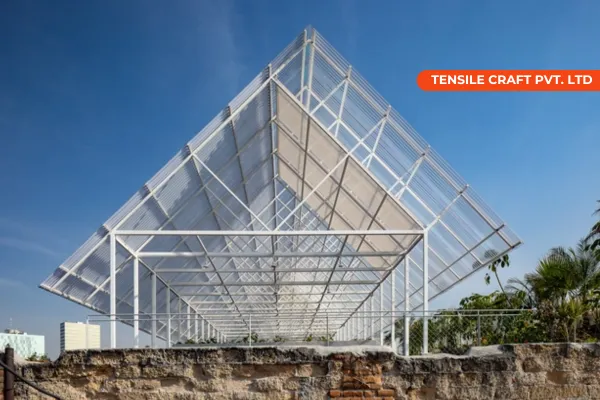
At Tensile Craft, we frequently combine polycarbonate with tensile steel frameworks, creating hybrid structures that offer the best of both worlds: sleek steel profiles with rigid, impact-resistant roofing.
Key Engineering Fact: Polycarbonate has a linear thermal expansion coefficient of 0.065 mm/m·K. In Delhi, where temperatures swing from 3°C to 48°C, a 3-meter sheet expands and contracts by approximately 8.7mm daily. If installers use tight screw holes without expansion gaps, the sheets will buckle and crack within one summer. This is the #1 failure mode in Indian polycarbonate structures.
1. Polycarbonate vs Tensile Fabric
Polycarbonate is a rigid thermoplastic, while PVC/PTFE is a flexible fabric. Both transmit light, but they behave fundamentally differently structurally.
- Tensile Fabric: Carries loads through tension only. Requires double curvature. Infinite design flexibility. Soft, shadow-free light.
- Polycarbonate: Carries loads as a bending member (like glass). Flat or single-curvature installations. High impact resistance (hail, stones). Rigid, architectural glazing look.
2. Solid vs Multiwall Sheets
A. Solid Polycarbonate Sheets
Looks like glass but is virtually unbreakable. Used for high-impact applications like entrance canopies where falling objects are a concern, or where a premium, transparent aesthetic is required. Typically 3mm-6mm thick. High cost (₹120-180/sq.ft. for the sheet alone).
B. Multiwall (Honeycomb) Polycarbonate Sheets
Two or more walls separated by vertical ribs, creating air pockets. This provides excellent thermal insulation (U-value of 2.0-2.4 W/m²K vs 6.0 for solid sheets). Light transmission is 50-80%. Available in 6mm, 10mm, 16mm, and 25mm thicknesses. The standard choice for car parking sheds and walkways. Cost-effective (₹60-110/sq.ft. for the sheet).
Engineering Detail — Condensation in Multiwall: In high-humidity environments (like pool enclosures), moisture can get inside the honeycomb ribs through the edges, causing algae growth and fogging. We mandate anti-dust tape on the top edge and breathable vent tape on the bottom edge of every multiwall sheet. Open edges void the warranty.
3. The Thermal Expansion Trap (0.065 mm/m·K)
Most polycarbonate failures in India are not material failures—they are installation failures caused by ignoring thermal expansion.
- Expansion Calculation: A 3m sheet × 45°C temperature swing × 0.065 mm/m·K = 8.7mm of expansion.
- Correct Installation: We drill 10mm oversize holes for 5mm screws. The screw is tightened down to an EPDM neoprene washer, which allows the sheet to slide micro-metrically under the washer as it expands, without cracking.
- Incorrect Installation: Tight screw holes and silicone sealant locking the sheet in place. The sheet tries to expand, has nowhere to go, and buckles or cracks at the stress points.
⚠ Warning — Sealant Abuse: Never use permanent silicone sealant on polycarbonate overlapping joints. It locks the sheets, preventing thermal movement, and the chemical acetic acid in some silicones attacks the polycarbonate, causing micro-crazing (spiderweb cracking). Use only specialized PC polycarbonate profiles (H-profiles, U-profiles) with rubber gaskets.
4. UV Co-Extrusion: The Yellowing Myth
"Polycarbonate turns yellow in 2 years." This is true for cheap, unbranded sheets, but false for premium UV-co-extruded sheets.
Premium polycarbonate has a 50-micron UV-absorbing layer co-extruded onto the surface during manufacturing. This layer absorbs 99.9% of UV radiation, preventing the polymer chains from breaking down (which causes yellowing and brittleness).
- Co-extruded UV Layer: Lasts 10-15 years. Warranted by manufacturers like SABIC, Exolon, and Gallina.
- UV Coating (Sprayed): Cheaper alternative. Wears off in 2-3 years when cleaned with brushes. Sheet yellows rapidly after coating failure.
5. Cost Analysis by Application (2026)
| Application | Sheet Type | Total Cost/sq.ft. (Installed) |
|---|---|---|
| Car Parking Shed | 10mm Multiwall | ₹300 - ₹380 |
| Walkway Cover | 10mm Multiwall | ₹320 - ₹400 |
| Entrance Canopy (Premium) | 5mm Solid | ₹400 - ₹500 |
| Skylight Glazing | 16mm Multiwall | ₹350 - ₹450 |
For full cost comparisons, see our Tensile Structure Cost India 2026 guide.
💰 Hybrid Savings: For large car parking, consider a hybrid structure: tensile PVC fabric for the main roof spans (cheaper per sq.ft.), combined with polycarbonate side panels to block wind-driven rain. This saves 15-20% compared to a full polycarbonate enclosure.
Get a Polycarbonate Quote
Share your application and size — we will recommend the correct sheet thickness and framing system.
Call: +91-9217718546Frequently Asked Questions
How much does a polycarbonate structure cost in India?
A polycarbonate canopy costs ₹300-500 per sq.ft. installed. Multiwall sheet structures cost ₹300-400/sq.ft., while solid sheet structures cost ₹400-500/sq.ft. A standard 10-car polycarbonate parking shed costs ₹6-8 lakhs.
What is the lifespan of a polycarbonate roof?
High-quality polycarbonate sheets with UV co-extrusion last 10-15 years in Indian conditions. Cheap sheets without UV protection turn yellow and brittle within 3-4 years. The steel framework lasts 40+ years.
Does polycarbonate turn yellow in the sun?
Only low-quality sheets without UV protection. Premium polycarbonate has a 50-micron UV co-extruded layer on the sun-facing side that prevents yellowing. This layer must face outward during installation; installing it upside down voids the warranty.
Can polycarbonate withstand hailstorms?
Yes. Solid polycarbonate is virtually unbreakable (250x stronger than glass) and easily withstands hailstorms. Multiwall (honeycomb) sheets are more vulnerable to large hail (2cm+) which can puncture the internal ribs, but generally survive standard hail.
Why do polycarbonate sheets crack at the screw holes?
Polycarbonate has a massive thermal expansion coefficient (0.065 mm/m·K). In Delhi, a 3m sheet expands/contracts 6-7mm daily. If screws are tightened without oversize holes and neoprene washers, the sheet cracks as it tries to expand. We use 10mm oversize holes and EPDM gaskets.
Which is better: polycarbonate or tensile fabric?
Tensile fabric is better for large spans, complex curves, and lightweight aesthetics. Polycarbonate is better for flat/sloped roofs requiring hard-surface durability, high impact resistance (hail/stone), and easy DIY panel replacement. For car parking, both work well.
Related Articles
Continue reading about tensile structures