


Table of Contents
- Why Tensile Walkways Are Growing in India
- Design Principles for Walkway Structures
- Design 1: Barrel Vault (Most Popular)
- Design 2: Hypar (Saddle) Wave
- Design 3: Conical Umbrella Row
- Design 4: Asymmetric Lean-To
- Design 5: Butterfly Wing
- Design 6: Trellis-Integrated
- Design 7: Cantilever Canopy
- Design 8: Multi-Level Tiered
- Design 9: Linear Sawtooth
- Design 10: Free-Form Organic
- Cost Comparison of All 10 Designs
- Where Each Design Works Best
- Frequently Asked Questions
Walkways are the connective tissue of any campus, industrial area, or institutional complex. In India's climate — where summer temperatures exceed 45°C and monsoon rains flood open paths — an uncovered walkway is not just uncomfortable, it is unusable for 4-5 months of the year.
Tensile walkway structures solve this problem with lightweight, elegant, and cost-effective covered corridors. At Tensile Craft, walkway coverings are our second-largest product category after tensile car parking — we have installed walkway structures at IT parks in Bangalore, hospital complexes in Delhi NCR, university campuses in Pune, and corporate headquarters in Hyderabad.
Quick Numbers: Tensile walkway covering costs ₹200-350 per sq.ft. in India. A 50-meter walkway (500 sq.ft.) costs ₹1-1.75 lakhs and installs in 5-8 days. Standard clear height is 2.2-3.5m. Lifespan: 15-30 years depending on fabric.
Why Tensile Walkways Are Growing in India
- IT/ITeS boom: Every new IT park, SEZ, and tech campus needs covered walkways connecting buildings. Tensile is the default choice because conventional corridors are too slow and expensive to build.
- Hospital expansions: Indian hospitals are adding multi-building complexes. Patients, visitors, and staff need sheltered movement between buildings — especially for OPD-to-ward, parking-to-entrance routes.
- Educational institutions: NAAC and UGC guidelines now recommend covered corridors in colleges and universities. Tensile structures meet this requirement at a fraction of civil construction cost.
- Metro and transport: Metro stations, bus terminals, and railway platforms increasingly use tensile walkways for passenger flow areas. Delhi Metro, Bangalore Metro, and Kochi Metro all use tensile-covered passages.
- Industrial campuses: Factories and warehouses need covered paths between production areas, canteens, and admin blocks — primarily for worker comfort and safety compliance.
Design Principles for Walkway Structures
Before diving into specific designs, here are the engineering principles that govern every tensile walkway — regardless of shape:
Width & Clear Height
- Single-direction pedestrian: Minimum 1.5m clear width, 2.2m clear height at lowest fabric point
- Two-direction pedestrian: Minimum 2.4m clear width
- Wheelchair accessible (CPWD): Minimum 1.8m width, level surface
- High-traffic (metro, mall): 3-4.5m width, 2.7m minimum height
- Fabric overhang: Extend 0.5-1m beyond walkway edge on each side for rain protection
Water Drainage
All walkway designs must ensure rainwater runs off the edges — never along the walkway surface where it would drip on pedestrians. This means the fabric must slope perpendicular to the walkway direction, not parallel to it. The minimum recommended slope is 15 degrees (27% grade).
Wind Considerations
Open-sided walkways are vulnerable to cross-winds. The structure must be designed as per IS 875 Part 3 for both perpendicular and parallel wind loads. Open sides mean the wind sees the full fabric area — there is no shielding effect from walls. Column design must account for significant uplift forces, especially at arch peak points.
Design 1: Barrel Vault (Most Popular)
01. Continuous Arch Barrel Vault
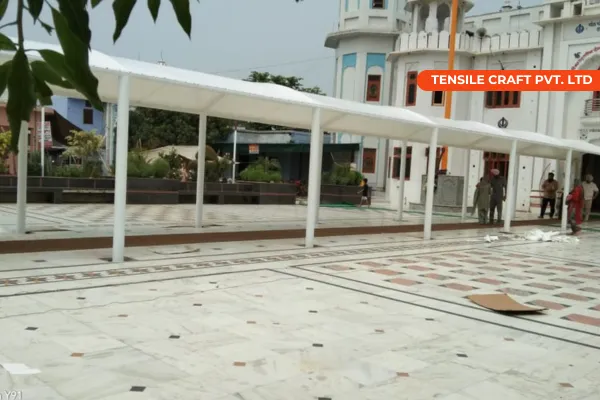
A series of identical arches running along the walkway, with fabric tensioned between them to create a smooth tunnel-like cover. This is by far the most used walkway design in India — we install more barrel vault walkways than all other designs combined.
Why it works: Every module is identical, which makes fabrication highly efficient — same arch, same fabric pattern, repeat. Water drains to both sides equally. The arched shape provides excellent headroom without excessive height. It looks clean and professional in any setting.
Best for: IT parks, hospital corridors, university campuses, factory walkways. Any linear path longer than 20 meters where uniform coverage is needed. Often combined with tensile entrance structures at both ends for a complete covered experience.
Design 2: Hypar (Saddle) Wave
02. Alternating Hypar Wave
A series of hypar (hyperbolic paraboloid) modules arranged along the walkway, with alternating high and low points creating a rhythmic wave pattern. This is the design to choose when you want visual distinction without significantly higher cost.
Why it works: The alternating high-low pattern creates natural visual rhythm. Water drains to the low points efficiently. The double curvature of each hypar module provides excellent structural stiffness. It looks more dynamic than a barrel vault and is preferred when the walkway is a prominent architectural feature.
Best for: Premium IT campuses, five-star hotel grounds, airport terminal corridors, and institutional entrances where the walkway itself is a design statement. Often used to connect gazebo structures or umbrella seating areas along a landscape path.
Design 3: Conical Umbrella Row
03. Conical Umbrella Modules
Individual conical (umbrella) tensile structures placed at regular intervals along the walkway, with or without connecting fabric between them. Each module is a self-contained shade point.
Why it works: Each unit is structurally independent — if one is damaged, the rest continue functioning. Water runs off each cone in all directions. The circular footprint fits naturally in garden and landscape settings. It is also the most economical walkway design per square meter of covered area.
Best for: Resort pathways, garden walks, residential township internal roads, and situations where the walkway has many turns or branches (conical units can be placed at any angle without alignment constraints).
Design 4: Asymmetric Lean-To
04. Single-Slope Lean-To
Fabric slopes from a high edge (attached to a building wall or a tall column row) down to a low edge on the opposite side. The walkway is fully covered on one side, open on the other.
Why it works: This is the most economical design because it uses the existing building wall as one support, requiring columns only on the outer edge. It works especially well when the walkway runs along the side of a building. Water drains to the outer low edge only.
Best for: Building-side walkways in factories, warehouses, and commercial complexes where the structure is attached to the main building. Also used for awning and canopy extensions along shop fronts.
Design 5: Butterfly Wing
05. Dual-Valley Butterfly
Two fabric surfaces slope downward from a central ridge beam, creating a butterfly-wing profile. The valley at the center can be designed as a drainage channel or left as a visual ridge.
Why it works: The central ridge creates a grander, more spacious feeling than a barrel vault. The dual-slope drainage is efficient. It provides excellent headroom at the centreline where most people walk. This design is chosen when the walkway is wide (3m+) and needs to feel open rather than tunnel-like.
Best for: Airport passenger corridors, large hospital complexes, convention centres, and premium corporate headquarters where the walkway is a prominent public-facing element.
Need a Walkway Design Consultation?
Share your walkway layout and we will recommend the optimal design with 3D visualisation.
Get Free Design ProposalDesign 6: Trellis-Integrated
06. Walkway with Climbing Plant Support
A tensile walkway structure with integrated steel trellis frames on one or both sides, designed to support climbing plants like bougainvillea, curtain creeper, or jasmine. The tensile fabric provides immediate shade while the plants grow to create a living canopy.
Why it works: Combines engineered tensile shading with natural greenery. Over 2-3 years, the climbing plants create a secondary shade layer that reduces under-canopy temperature by an additional 3-5°C beyond what the tensile fabric alone achieves. The trellis is fabricated from the same galvanized steel as the main structure.
Best for: Luxury resorts, heritage hotel properties, residential township landscape corridors, and institutional campuses with landscaping budgets. This design is particularly popular in garden and landscape projects.
Design 7: Cantilever Canopy
07. Wall-Mounted Cantilever Walkway
The entire walkway covering is cantilevered from a building wall or a single row of columns, with no outer supports. The fabric slopes outward from the mounting point.
Why it works: Eliminates outer columns completely, keeping the walkway surface clear for movement and maintenance. Essential when the walkway is narrow or when columns would obstruct trolley movement (airports, hospitals). The cantilever engineering requires heavier steel sections, which increases cost.
Best for: Airport terminal corridors, hospital ward-to-diagnostic paths, mall atrium walkways, and any situation where column-free ground surface is critical. Often used at building entrances extended into walkway form.
Design 8: Multi-Level Tiered
08. Stacked Tiered Walkway
Two or three levels of tensile walkway stacked vertically, connected by stairs or ramps, covering different floor levels of a building complex. Each tier has its own fabric membrane and steel support system.
Why it works: Provides covered connectivity between building floors without going through the building interior. This is valuable for factories (shop floor to admin block), hospitals (ground floor to first floor OPD), and multi-level parking structures. Each level can use a different fabric colour to aid wayfinding.
Best for: Multi-level car parking structures, factory complexes with elevated walkways, hillside institutional campuses, and multi-level car parking pedestrian connections.
Design 9: Linear Sawtooth
09. Industrial Sawtooth Profile
A series of sloped fabric panels arranged in a sawtooth (zigzag) profile along the walkway, with vertical glazing or open slots on the high side. Adapted from industrial sawtooth roof design.
Why it works: The vertical slots on the high side allow hot air to escape while keeping rain out (the slots face away from prevailing wind/rain direction). This creates natural convection cooling — hot air rises out through the slots, drawing cooler air through the open walkway sides. Temperature reduction of 5-8°C is achievable compared to a closed barrel vault.
Best for: Factory walkways in hot climates (Gujarat, Rajasthan, Tamil Nadu), industrial corridors, and tensile roof structures where passive cooling is required. Not recommended for very windy or monsoon-heavy locations.
Design 10: Free-Form Organic
10. Parametric Free-Form
A custom-designed walkway with flowing, organic curves that do not repeat. Every module may have a unique shape. The form is generated using parametric design software and requires individual fabrication patterns for each fabric panel.
Why it works: Creates a one-of-a-kind architectural statement that no other walkway design can match. The organic forms can follow the natural contours of a landscape, wrap around existing trees, or create dramatic spatial experiences at key points in a campus. This is tensile architecture at its highest level.
Best for: Iconic public projects, museum and art gallery corridors, premium hotel entrances, and government buildings where the walkway is a landmark feature. Requires a design-conscious client and a higher budget.
Cost Comparison of All 10 Designs
| # | Design | Cost/sq.ft. | Fabric Wastage | Install Time |
|---|---|---|---|---|
| 01 | Barrel Vault | ₹200-280 | 5-8% | Fast |
| 02 | Hypar Wave | ₹230-320 | 8-12% | Medium |
| 03 | Conical Row | ₹180-260 | 10-15% | Fast |
| 04 | Lean-To | ₹180-250 | 3-5% | Very Fast |
| 05 | Butterfly Wing | ₹260-350 | 8-12% | Medium |
| 06 | Trellis-Integrated | ₹280-380 | 5-8% | Medium-Slow |
| 07 | Cantilever | ₹300-400 | 5-8% | Slow |
| 08 | Multi-Level | ₹350-500 | 8-12% | Slow |
| 09 | Sawtooth | ₹300-420 | 10-15% | Slow |
| 10 | Free-Form | ₹400-600 | 15-25% | Very Slow |
Fabric wastage is a critical cost factor that most people ignore. Standard barrel vault and lean-to designs waste only 5-8% of fabric because the patterns are repetitive rectangles. Free-form designs can waste 15-25% because each panel is a unique shape with irregular edges that cannot be nested efficiently on the fabric roll. For a 500 sq.ft. walkway, the difference between 5% and 20% wastage is ₹3,000-12,000 in fabric cost alone.
For the overall cost structure of tensile projects, see our Tensile Structure Cost in India 2026 guide.
Where Each Design Works Best
| Application | Recommended Design | Alternative |
|---|---|---|
| IT Park / SEZ Campus | Barrel Vault | Hypar Wave (for visual impact) |
| Hospital Complex | Barrel Vault | Cantilever (entrance corridor) |
| University Campus | Hypar Wave | Barrel Vault |
| Factory / Warehouse | Lean-To or Sawtooth | Barrel Vault |
| Airport Terminal | Butterfly Wing | Cantilever |
| Hotel / Resort | Trellis-Integrated | Conical Row (garden paths) |
| Residential Township | Conical Row | Lean-To (building-side) |
| Metro Station | Cantilever | Barrel Vault |
| Mall / Commercial | Butterfly Wing | Hypar Wave |
| Multi-Level Parking | Multi-Level Tiered | Barrel Vault (per level) |
| Public / Government | Free-Form | Butterfly Wing |
Discuss Your Walkway Project With Us
Send us your site plan or Google Maps screenshot — we will suggest the optimal design, span, and cost estimate.
Call: +91-9217718546Frequently Asked Questions
What is the best design for a tensile walkway?
Barrel vault is the most popular design for tensile walkways because it provides uniform coverage along a linear path, efficient water drainage, and costs ₹200-350 per sq.ft. For short walkways with visual impact, hypar (saddle) designs work well. For intersection junctions, conical umbrella modules are ideal.
What is the cost of tensile walkway covering in India?
Tensile walkway covering costs ₹200-350 per sq.ft. (all-inclusive) in India. For a 50-meter long, 3-meter wide walkway (500 sq.ft.), total cost ranges from ₹1,00,000 to ₹1,75,000. Cost varies by design complexity, fabric choice, and city location.
How wide should a tensile walkway be?
For single-direction pedestrian flow: minimum 1.5m (5 ft) wide. For two-way flow: minimum 2.4m (8 ft) wide. For wheelchair accessibility (as per CPWD guidelines): minimum 1.8m (6 ft). For high-traffic areas like metro stations: 3-4.5m (10-15 ft) wide. The structure overhang should extend 0.5-1m beyond the walkway width on each side for rain protection.
Can tensile walkways handle Indian monsoon rain?
Yes. Tensile walkway structures are designed with 15-25 degree slopes for rapid water runoff. The pre-tensioned fabric prevents sagging and water ponding. Designed as per IS 875 Part 3 for wind loads, they handle monsoon rainfall of 100-200 mm/hour without any leakage. Water is directed to the edges through the fabric's natural curvature.
What is the minimum height for a tensile walkway?
Minimum clear height under the fabric at the lowest point should be 2.2m (7.2 ft) for pedestrian walkways as per NBC of India. For walkways with trolley movement (airports, malls), minimum 2.7m (9 ft) is recommended. At the arch peak, height typically ranges from 3.5m to 5m depending on span and design.
Does tensile walkway need side walls?
No. Tensile walkways are open-sided by design — this provides natural ventilation and prevents the tunnel effect during windy conditions. Side curtains (fabric or polycarbonate) can be added for rain protection in high-wind locations or for enclosed corridors, but this increases cost by 40-60% and may require additional structural support.
Related Articles
Continue reading more about tensile structures
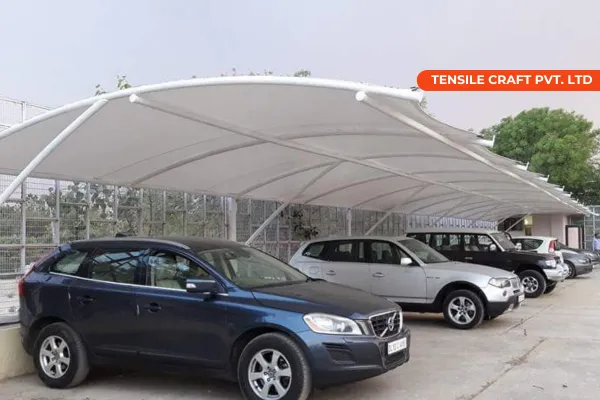
Tensile Car Parking: Ultimate Guide 2026
The most detailed guide on tensile car parking — designs, costs, fabrics, and installation for India.
Car Parking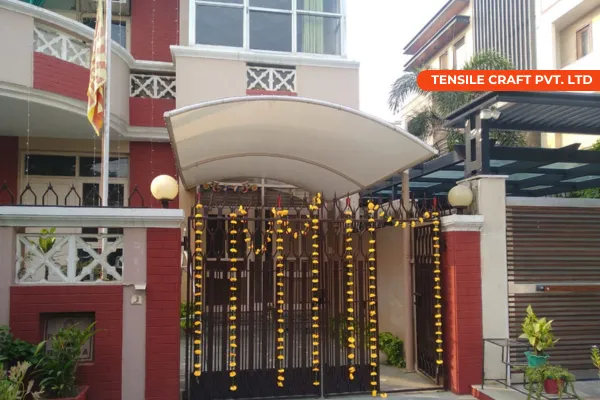
Tensile Entrance Structures: Make a Lasting Impression
Design ideas for hotel, mall, office, and residential entrance canopies using tensile structures.
Entrance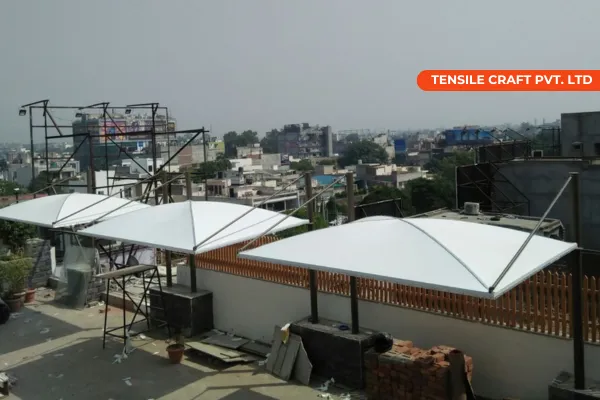
Tensile Structure Cost in India 2026
Per sq.ft. pricing for all walkway designs — cost factors and money-saving strategies.
Cost Guide