



Table of Contents
A swimming pool without a cover is like leaving your AC running with the windows open — you are paying heavily for water, chemicals, and electricity while losing most of it to evaporation and debris. In India's climate, where summer temperatures drive pool water loss of 10-15mm per day, an uncovered pool loses 15,000-30,000 litres every month just to evaporation.
A swimming pool tensile structure solves this problem while adding a stunning architectural element to your property. At Tensile Craft, we have installed pool covers for residential villas in Delhi NCR, hotel pools in Goa, resort pools in Rajasthan, and institutional pools across India.
Quick Numbers: Pool tensile structures cost ₹250-450 per sq.ft., install in 5-10 days, reduce water evaporation by 50-70%, block 98%+ UV rays, and last 15-20 years. A standard residential pool cover (450 sq.ft.) costs ₹1.1-2.0 lakhs.
Why Cover Your Swimming Pool?
The benefits go far beyond simple shade. Here is what a tensile cover actually does for your pool:
- Reduces water evaporation by 50-70%: For a 40,000-litre pool in Delhi summer, this saves 12,000-20,000 litres per month — roughly ₹600-1,000 in water bills. Over 15 years, that is ₹1-1.8 lakhs in water savings alone.
- Blocks UV radiation: UPF 50+ protection stops sunburn, reduces skin cancer risk for swimmers, and prevents pool surface degradation from UV exposure.
- Reduces chemical consumption by 30-50%: Less sunlight means slower chlorine degradation, so you use less pool chemicals. Most pool owners save ₹2,000-5,000 per month on chemical costs.
- Keeps debris out: Leaves, dust, bird droppings, and insects are blocked. This reduces filter cleaning frequency by 50-60% and extends filter media life.
- Lowers water temperature by 5-8°C: Shaded pool water stays significantly cooler, providing a more comfortable swimming experience during summer.
- Extends swimming season: In North India, a covered pool can be used comfortably from March to November instead of May to September — adding 2 extra months of usability.
- Aesthetic upgrade: A well-designed tensile cover transforms a plain pool into a resort-quality feature. This is why hotels, resorts, and luxury homes almost always specify tensile covers.
5 Types of Pool Tensile Structures
1. Conical Umbrella (Single Point)
One central mast with fabric sloping down to a circular base. Ideal for small to medium residential pools. Provides uniform shade over a circular area. Based on tensile umbrella structure engineering.
Best for: Round pools, plunge pools, small lap pools up to 200 sq.ft. Cost: ₹250-350/sq.ft.
2. Twin Conical (Two Points)
Two conical peaks connected by a shared valley beam, covering a rectangular pool area. More efficient than two separate umbrellas because the shared beam reduces steel per sq.ft. This is the most popular design for residential pools in India.
Best for: Standard residential pools (15x30 ft to 25x50 ft). Cost: ₹220-320/sq.ft.
3. Barrel Vault (Arched)
A smooth arched cover spanning the full length of the pool, supported by columns at each end. Provides complete pool coverage with clean aesthetics. Most suitable for lap pools and long rectangular pools.
Best for: Lap pools, competition pools, long rectangular pools. Cost: ₹280-400/sq.ft. (higher because of wider spans requiring heavier arch sections).
4. Hypar (Saddle) — Most Premium
Two high points and two low points creating a hyperbolic paraboloid shape over the pool. The most visually striking option with excellent drainage. Water runs to all four corners, ensuring no dripping along the pool edge.
Best for: Infinity pools, hotel resort pools, architect-designed residential pools. Cost: ₹300-450/sq.ft.
5. Cantilever (Wall-Mounted)
The entire cover is cantilevered from one side — typically from the existing pool room wall — with no columns on the open side. This maximises the open poolside area and provides unobstructed views.
Best for: Rooftop pools, hotel pools with scenic views, residential pools where columns would obstruct the landscape. Cost: ₹320-450/sq.ft.
⚠️ Important: For the cantilever design, the supporting wall must be confirmed by a structural engineer to have adequate load-bearing capacity. Tensile Craft can provide this assessment if needed.
Fabric Selection: The Chlorine Challenge
Swimming pools present a unique challenge for tensile fabrics: chlorine exposure. Unlike car parking or walkway structures, a pool cover sits directly above chlorinated water. The chlorine doesn't contact the fabric directly, but chlorine gas (which is heavier than air) accumulates in the air space between the water surface and the fabric underside.
What the Standards Say
International standards (DIN 16726-1 for PVC coated fabrics, ASTM D4417) define two exposure classes for PVC fabrics in pool environments:
- Class 3 (Low chlorine exposure): For residential pools with normal chlorine levels (1-3 ppm free chlorine). Standard PVC+PVDF fabric is adequate.
- Class 4 (High chlorine exposure): For public/semi-public pools with heavy chlorine dosing, shock chlorination, or saltwater pools. Requires specially formulated chlorine-resistant PVC or PTFE fabric.
Our Recommendation
| Fabric | Pool Type | Chlorine Resistance | Lifespan | Cost/sq.m. |
|---|---|---|---|---|
| PVC + PVDF (Standard) | Residential (1-3 ppm) | Adequate | 15-20 years | ₹380-650 |
| PVC + PVDF (CR Grade) | Semi-public, hotel (3-5 ppm) | Enhanced | 15-20 years | ₹450-750 |
| PTFE (Premium) | Public, Olympic, saltwater | Excellent | 25-30 years | ₹800-1,200 |
For 90% of residential pool owners with standard chlorine maintenance, PVC + PVDF is the correct and sufficient choice. PTFE is recommended for public swimming pools, saltwater pools, and projects where the client specifically demands 25-30 year fabric life. For the complete fabric comparison, read our PTFE vs PVC comparison guide.
Important: Regardless of fabric choice, the minimum height from water surface to fabric must be 3 meters (see next section) to ensure chlorine fumes remain below breathing level. This is non-negotiable for pool safety.
Need a Pool Cover Design?
Share your pool dimensions, type (residential/hotel/public), and location — we will suggest the best design and send a detailed quotation.
Get Free QuotationCost for Different Pool Sizes
Here are realistic 2026 costs for different pool types. All rates are all-inclusive (design + steel + fabric + installation + GST):
| Pool Type | Approx. Size | Coverage Area | Recommended Design | Total Cost Range |
|---|---|---|---|---|
| Small Residential | 15x30 ft | 250-350 sq.ft. | Twin Conical | ₹55,000 - ₹1,05,000 |
| Standard Residential | 20x40 ft | 400-550 sq.ft. | Twin Conical | ₹88,000 - ₹1,65,000 |
| Large Residential | 25x50 ft | 550-750 sq.ft. | Twin Conical / Hypar | ₹1,20,000 - ₹2,25,000 |
| Lap Pool | 75x25 ft | 400-500 sq.ft. | Barrel Vault | ₹1,10,000 - ₹1,80,000 |
| Plunge Pool | 20x10 ft (round) | 150-250 sq.ft. | Conical Umbrella | ₹37,000 - ₹75,000 |
| Hotel Pool | 50x100 ft | 1,200-1,600 sq.ft. | Hypar / Cantilever | ₹2,40,000 - ₹5,40,000 |
| Resort Pool (Infinity) | 80x40 ft | 800-1,200 sq.ft. | Hypar | ₹1,60,000 - ₹4,50,000 |
| Public / Olympic | 50x25m | 2,500-3,500 sq.ft. | Barrel Vault Multi-Span | ₹6,25,000 - ₹12,25,000 |
Note: Coverage area is always larger than the pool water surface — typically 1-1.5m overhang on each side to prevent splash-out and sunlight from hitting the water at angles. A 20x40 ft pool (800 sq.ft. water surface) needs approximately 900-1,100 sq.ft. of fabric cover.
For complete pricing methodology, see our Tensile Structure Cost in India 2026 guide.
Height & Clearance Requirements
This is the most critical — and most commonly overlooked — specification for pool tensile structures:
| Parameter | Minimum | Recommended | Why |
|---|---|---|---|
| Fabric low point to water surface | 3.0m (10 ft) | 3.0-3.5m | Chlorine fumes are heavier than air and accumulate below the fabric. Below 3m, they enter the breathing zone, causing eye irritation, coughing, and respiratory discomfort for swimmers below. |
| Fabric peak height | 3.5m | 3.5-5m | Sufficient headroom for safe pool usage. For diving pools, minimum 4.5-5m at the diving end. |
| Side overhang beyond pool edge | 0.5m | 0.8-1.2m | Prevents rain splash and sunlight from hitting the water at low angles, maximises UV protection. |
| Distance from fabric to diving board | 1.0m vertical | 1.2-1.5m vertical | FINA and IOS standards require minimum 1m clear above diving board surface. |
| Distance from fabric to pool equipment | 0.5m | 1m | Access for filter, pump, and lighting maintenance without hitting the fabric. |
⚠️ Safety Warning: Several Indian installers provide pool covers at only 2-2.5m height to reduce cost. This is dangerous. At this height, swimmers experience chlorine irritation within 15-20 minutes of entering the pool. Always insist on minimum 3m clearance. At Tensile Craft, we will not install below 3m regardless of the client's budget request.
Chlorine Ventilation: The Critical Factor
Chlorine gas (molecular weight 70.9) is 2.4 times heavier than air (molecular weight 29). In an enclosed pool area, it settles in the air space between the water surface and the overhead cover. This is why pool covers must be designed for ventilation, not just shade.
Three Ventilation Strategies
- Adequate height (primary): The 3m minimum clearance between water and fabric creates enough air volume to dilute chlorine fumes to safe levels. For standard residential pools with 1-3 ppm chlorine, 3-3.5m is sufficient.
- Open sides (secondary): If at least one side of the pool is open to air (no wind barrier within 10m), natural ventilation will dissipate chlorine fumes effectively. This is the most common residential pool configuration.
- Mechanical ventilation (for enclosed pools): For indoor pools, fully enclosed resort pools, or pools in wind-sheltered locations, mechanical exhaust fans may be needed. We specify these when the site conditions require it.
Side Curtains: Yes or No?
Some clients ask for side curtains (fabric panels hanging from the cover edges) for privacy or rain protection. We recommend against side curtains for swimming pools for two reasons:
- Chlorine trap: Side curtains create a semi-enclosed space that traps chlorine gas between the fabric cover and curtains. This significantly increases chlorine concentration in the breathing zone.
- Wind blockage: Curtains block the natural cross-ventilation that keeps the air fresh between water and cover. Without this ventilation, chlorine irritation becomes a real problem even with 3m clearance.
If side protection from rain or wind is essential, we recommend polycarbonate sheet panels instead of fabric curtains — they are rigid, do not trap air, and allow light through. The polycarbonate vs tensile comparison guide has full details.
Tensile vs Other Pool Cover Options
| Parameter | Tensile Structure | Polycarbonate Sheet | Roller Shutter | Safety Cover (Bubble Wrap) |
|---|---|---|---|---|
| Cost (20x40ft pool) | ₹88K - ₹1.65L | ₹60K - ₹1.10L | ₹40K - ₹80K | ₹15K - ₹30K |
| Lifespan | 15-30 years | 10-15 years | 5-8 years | 3-5 years |
| UV Protection | UPF 50+ (98%+ blocked) | Partial (80-90%) | None | None |
| Evaporation Reduction | 50-70% | 40-50% | 0% | 0% |
| Water Temperature Reduction | 5-8°C | 2-4°C | 0°C | 0°C |
| Aesthetic Appeal | Excellent | Good | Poor (industrial look) | Poor (bubble wrap look) |
| Wind Resistance | Up to 150 km/h (IS 875) | Up to 120 km/h | Up to 80 km/h | Up to 40 km/h (not rated for wind) |
| Chlorine Resistance | Good (PVC+PVDF) | Excellent (inherent) | N/A | N/A |
| Annual Maintenance | ₹2,000-5,000 | ₹3,000-8,000 | ₹5,000-15,000 | ₹2,000-5,000 |
Verdict: Tensile structures are the only option that combines UV protection, evaporation reduction, aesthetic appeal, and durability in one solution. Polycarbonate is a cheaper alternative for basic shade but lacks the architectural quality. Roller shutters and safety covers are utility products, not design solutions. For a resort or luxury home, tensile is the only serious choice.
Maintenance for Pool Tensile Structures
Pool covers require slightly more attention than car parking because of the chlorine environment. Here is the maintenance protocol we recommend to our clients:
Weekly
- Visually inspect for any fabric sagging, loose bolt connections, or signs of discoloration
- Check if water is dripping anywhere from seams or edges (indicates seam welding failure — contact manufacturer immediately)
Monthly
- Clean the fabric underside with a soft brush and mild soap solution — chlorine can cause a slight yellowing of PVC over time, which regular cleaning prevents
- Check base plate grouting for cracks (chlorine-rich air can accelerate concrete degradation more than normal)
- Inspect steel members near the water surface for any rust spots — apply zinc-rich primer + matching paint immediately if found
Quarterly
Annually
- Professional inspection by the manufacturer or structural engineer
- Full steel condition assessment — especially the lower portions closest to chlorinated air
- Foundation condition check — chlorine attacks concrete more aggressively than normal atmospheric conditions
- Reapply anti-chlorine protective coating on steel if specified in the project specifications
Pro Tip: If your pool uses a salt chlorinator (saltwater pool), the entire steel framework must be upgraded to duplex coating (galvanizing + zinc-rich epoxy + polyurethane top coat) instead of standard galvanizing + powder coating. Salt spray is significantly more corrosive than standard chlorine. This adds approximately 10-12% to the steel cost but is essential for saltwater pool longevity. See our 20 Maintenance Tips for the complete guide.
Planning a Pool Tensile Structure?
Share your pool dimensions, type, and location — we will recommend the optimal design with chlorine-safe specifications.
Call: +91-9217718546Frequently Asked Questions
Can tensile structure be used over swimming pool?
Yes, tensile structures are one of the best covering options for swimming pools. They provide UV protection, reduce debris in the pool, lower water evaporation by 50-70%, and look far more attractive than conventional sheds. The fabric used is specifically rated for chlorine-resistant environments.
What fabric is best for swimming pool tensile cover?
PVC-coated polyester with PVDF top coat is the standard choice. It costs ₹380-650 per sq.m., lasts 15-20 years, and provides adequate chlorine resistance for residential pools. For premium installations, PTFE fabric offers superior chemical resistance and 25-30 year life but costs 2-3x more. PTFE is recommended for public swimming pools, Olympic pools, and saltwater pools.
Does tensile cover reduce pool water evaporation?
Yes, significantly. A tensile cover reduces water evaporation by 50-70% compared to an open pool. For an average residential pool (40,000-60,000 litres), this saves 15,000-30,000 litres per month — a substantial saving in water bills and refilling time, especially during Indian summers when evaporation is highest.
What is the cost of swimming pool tensile structure?
Swimming pool tensile structure costs ₹250-450 per sq.ft. (all-inclusive) in India. For a standard 30x15 ft residential pool (450 sq.ft. coverage), total cost ranges from ₹1,12,000 to ₹2,02,500. Larger hotel pools (80x40 ft, 1,200 sq.ft.) cost ₹3,00,000 to ₹5,40,000.
Does chlorine damage tensile fabric?
Standard pool chlorine levels (1-3 ppm free chlorine) do not significantly damage PVC+PVDF tensile fabric over its 15-20 year life. However, concentrated chlorine exposure (during shock chlorination with 10+ ppm) or direct contact with undiluted pool chemicals can degrade the fabric. The structure should have adequate height (3-3.5m minimum) and ventilation to disperse chlorine fumes.
What is the minimum height for pool tensile structure?
Minimum 3 meters (10 ft) from water surface to fabric at the lowest point. This allows safe headroom for swimmers and ensures chlorine fumes — which are heavier than air — are above breathing height. For diving pools, the minimum increases to 4.5-5 meters at the diving end.
Related Articles
Continue reading more about tensile structures
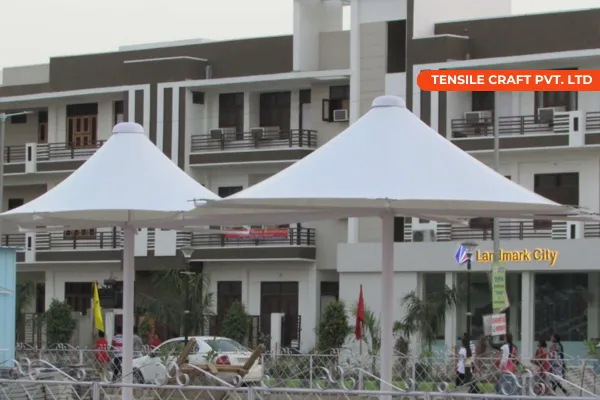
Tensile Gazebo Structures: Transform Outdoor Spaces
Complete guide to tensile gazebo structures for gardens, resorts, and luxury homes — designs, pricing, and installation in India.
Gazebo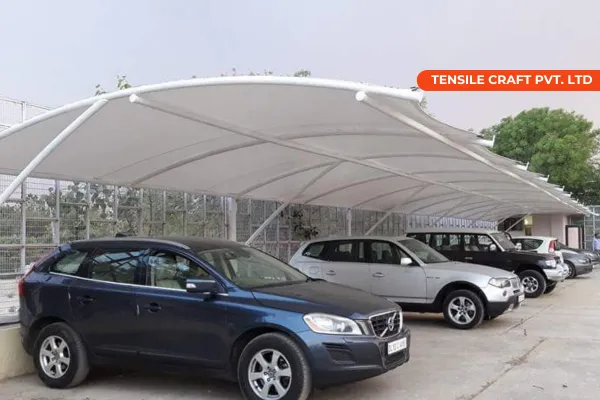
Tensile Car Parking: Ultimate Guide 2026
Designs, costs, fabrics, and installation — everything about tensile car parking in India.
Car Parking
20 Expert Maintenance Tips for Longevity
Proven strategies to extend your tensile structure's life by 15+ years — including chlorine-specific guidance for pool covers.
Maintenance