

Table of Contents
Tensile design has evolved from purely functional canopies into a sophisticated architectural language. Where early tensile structures simply mimicked tent shapes, modern tensile architecture uses computational physics to generate organic, futuristic forms that define the identity of entire cities.
At Tensile Craft, we are shifting from being just fabricators to being design-engineering partners. This guide explores the global trends shaping the tensile architecture of 2026 and beyond.
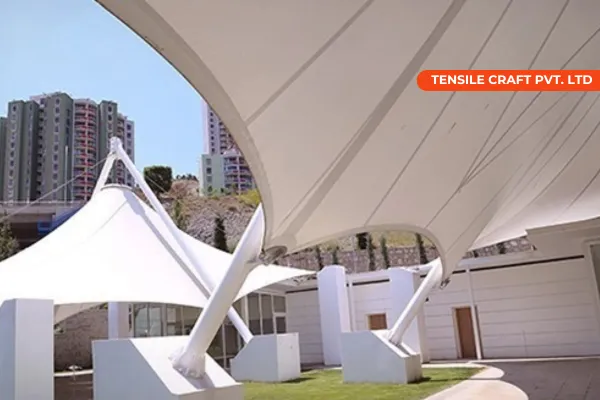
The Architectural Shift: Concrete and steel force architecture into straight lines and right angles because those are the shapes bending members prefer. Tensile fabric forces architecture into curves and anticlastic surfaces because those are the shapes tension prefers. The result is architecture that looks like it is breathing—fluid, organic, and impossibly light.
1. The Shift from Structure to Architecture
Historically, tensile structures were treated as "add-ons"—a car parking shade or a basic entrance canopy slapped onto a building after it was designed. Today, architects are designing buildings where the tensile membrane IS the defining architectural element.
- Integrated Design: The steel masts and fabric membranes are designed alongside the RCC frame, not after it.
- 夜间建筑 (Night Architecture): Because tensile fabric is translucent, the structure becomes a glowing beacon at night, entirely changing the building's identity after sunset.
2. Trend 1: Biomimicry & Organic Forms
Biomimicry is the practice of imitating nature’s engineering. A spider’s web uses minimal thread to span massive distances using pure tension—exactly what a tensile membrane does.
- Leaf Venation: The branching pattern of cables mimics how a leaf distributes stress from the stem to the edges, allowing massive canopies with minimal steel.
- Soap Bubble Physics: A soap bubble finds its shape based on minimal surface area. Tensile form-finding software uses the exact same physics to calculate the most structurally efficient fabric shape.
3. Trend 2: ETFE Dynamic Facades
While PVC and PTFE dominate roofs, ETFE (Ethylene Tetrafluoroethylene) is rapidly dominating vertical facades. ETFE is a transparent film that replaces glass in iconic structures.
- 1% the weight of glass: A 1mm ETFE film does the job of a 25mm laminated glass panel. This saves millions in steel framing costs for high-rise facades.
- Pneumatic Cushions: Two or three layers of ETFE are welded together and inflated with air, creating transparent, insulating pillows. By adjusting the air pressure, the cushions can change their thermal insulation dynamically.
- Printability: ETFE can be printed with dot-matrix patterns (fritting) to control solar gain—more dots on the south side, fewer on the north.
4. Trend 3: LEED & Sustainable Daylighting
Corporate and IT park architects are targeting LEED (Leadership in Energy and Environmental Design) certification. Tensile structures directly contribute to two critical LEED credits.
💰 LEED Credit Breakdown:
1. EA Credit (Energy Optimization): Translucent PTFE roofs provide 20-25% daylight transmission, reducing artificial lighting loads by 30-40% during daytime. For a 100,000 sq.ft. IT park, this saves ₹30-40 lakhs annually in HVAC and lighting.
2. SS Credit (Heat Island Reduction): White PTFE fabric reflects 70% of solar radiation. The roof surface stays 30-40°C cooler than a dark concrete roof, drastically reducing the building's cooling load.
5. The Computational Design Process
You cannot draw a tensile structure in AutoCAD. Because the fabric shape is dictated by tension, architects must use computational form-finding tools.
Engineering Detail — Rhino + Kangaroo: We use Grasshopper's Kangaroo physics engine. We input the boundary conditions (mast heights, edge cable locations) and apply a virtual "upward wind" force. The software simulates the physics in real-time, stretching the digital mesh until it finds the natural equilibrium shape—the minimal surface. This guarantees that the manufactured fabric will have zero wrinkles when installed.
Design Your Architectural Project
Share your architectural vision — our computational design team will provide form-finding and 3D renders.
Get Design ConsultationFrequently Asked Questions
What is tensile architecture?
Tensile architecture is a structural design philosophy where buildings use tensioned fabric membranes (PVC, PTFE, ETFE) instead of conventional rigid materials. It creates lightweight, sweeping, organic forms that are impossible with concrete and steel alone, focusing on minimal material usage and maximum spatial impact.
What is biomimicry in tensile design?
Biomimicry in tensile design means imitating nature’s structural forms—like spider webs, leaves, or soap bubbles—to create efficient, lightweight structures. Tensile fabric naturally mimics biological membranes, using curvature and tension rather than heavy mass to achieve strength.
How does tensile architecture help LEED certification?
Tensile structures contribute to LEED credits in two main ways: (1) Daylighting credits (10-25% light transmission reduces artificial lighting by 30-40%), and (2) Heat Island Reduction (light-colored PTFE/PVC fabrics reflect solar radiation, reducing roof temperatures by 30-40°C compared to dark concrete).
What is ETFE and why is it trending?
ETFE (Ethylene Tetrafluoroethylene) is a fluoropolymer film used instead of glass. It is 1% the weight of glass, transmits 95% of light, self-cleans, and can be inflated into pneumatic cushions for insulation. It is trending for stadium facades and bio-domes (like the Eden Project).
How do architects design tensile structures?
Architects use computational form-finding software (like Rhino + Kangaroo) that simulates physics. Instead of drawing the shape manually, they input boundary conditions (masts, edges) and let the software calculate the natural, minimal surface the fabric will take under tension. This ensures zero wrinkling.
Can tensile structures be permanent buildings?
Yes. PTFE-coated fiberglass membranes have a 25-30 year lifespan and are completely fireproof (A2 rating). Major airports, stadiums, and transit hubs worldwide use PTFE tensile structures as permanent, maintenance-free roofing systems.
Related Articles
Continue reading about tensile structures
Tensile Fabric Structure Types
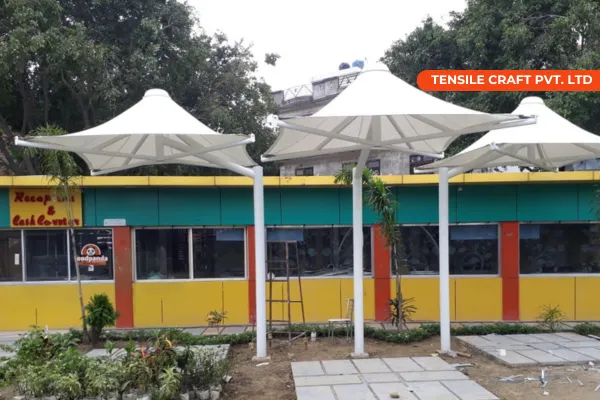
The taxonomy of shapes: Cones, Hypars, Domes, and Barrel Vaults.
Fabric Types