


Table of Contents
In tensile structure types, we covered the shapes—cones, hypars, and vaults. But those shapes are just geometry. The tensile membrane itself—the fabric skin that carries the wind, rain, and structural tension—is where the real materials science happens.
A membrane is not a simple tarpaulin. It is a composite material engineered to withstand 150 km/h winds, 48°C heat, and 15 years of UV radiation, all while weighing just 1 kg per square meter. At Tensile Craft, understanding this material at a microscopic level is what separates our engineering from generic fabricators.
Core Material Fact: Architectural tensile membranes are composite laminates. They consist of a structural base yarn (polyester or fiberglass) that carries the tension, encased in protective coatings (PVC or PTFE) that provide UV resistance, waterproofing, and self-cleaning properties. The yarn is the skeleton; the coating is the skin.
1. The Membrane: The Skin of the Structure
The membrane is the single most important component of a tensile structure. It must simultaneously be strong enough to resist hurricane winds, waterproof enough to handle monsoon deluges, and translucent enough to provide natural daylight.
- Tension Carrier: The woven base yarn resists the pulling forces (pre-tension + wind).
- Weather Shield: The polymer coating prevents water ingress and blocks UV radiation from degrading the yarn.
- Aesthetic Surface: The topcoat determines the color, translucency, and dirt-repellent (self-cleaning) properties.
2. Anatomy: Yarn, Coating, and Topcoat
To understand why membranes fail or succeed, you must understand their three-layer anatomy:
A. The Base Yarn (The Structural Skeleton)
The yarn is woven in two perpendicular directions: Warp (lengthwise, stronger) and Weft/Fill (widthwise). The tensile strength of the fabric is entirely determined by the denier (thickness) and tenacity (strength) of this yarn.
- Polyester Yarn (for PVC): High tenacity, 1000-2000 dtex. Extremely strong and slightly elastic, allowing PVC to stretch into complex curves.
- Fiberglass Yarn (for PTFE): Zero elasticity. Once manufactured, PTFE cannot stretch to accommodate construction tolerances. This makes PTFE fabrication extremely precise—and unforgiving of errors.
B. The Coating (The Weather Shield)
The yarn is completely encased in a polymer coating to seal it from moisture and UV light. If UV reaches polyester yarn, it degrades rapidly (hydrolysis), causing the fabric to lose 50% strength in 2-3 years.
- PVC (Polyvinyl Chloride): Flexible, weldable, available in colors. Coating weight: 400-800 gsm.
- PTFE (Polytetrafluoroethylene / Teflon): Chemically inert, completely immune to UV. Applied as a paste and sintered at 380°C. Coating weight: 800-1200 gsm.
C. The Topcoat (The Self-Cleaning Layer)
Without a topcoat, PVC is porous and dirt sticks to it permanently, turning the white fabric black within a year.
- Acrylic Topcoat: Cheap, very thin. Provides basic dirt resistance for 2-3 years. We never use this for architectural projects.
- PVDF Topcoat (Polyvinylidene Fluoride): The industry standard. Creates a smooth, non-stick surface (like a frying pan). Dirt washes off with rain. Lasts 10-15 years. Standard on all Tensile Craft installations.
- TiO2 (Titanium Dioxide): The premium option. Photocatalytic—uses UV light to actively break down organic dirt. Keeps PTFE brilliant white for 30 years.
3. The Big 3: PVC vs PTFE vs ETFE
While PTFE vs PVC is covered in detail in our dedicated guide, here is the structural engineering summary:
| Parameter | PVC/Polyester | PTFE/Fiberglass | ETFE Foil |
|---|---|---|---|
| Tensile Strength | 4,000-8,000 N/5cm | 8,000-12,000 N/5cm | 500-600 N/5cm |
| Elasticity | 1-3% stretch (Accommodating) | <0.5% stretch (Rigid) | 10-15% stretch (Highly elastic) |
| Fire Rating | B1 (Self-extinguishing) | A2 (Non-combustible) | B1 (Self-extinguishing, melts away) |
| Translucency | 5-15% | 15-25% | Up to 95% |
| Lifespan | 15-20 years | 25-30 years | 20-25 years |
4. Biaxial Testing & Compensation Factors
You cannot simply take a 3D CAD model and flatten it to cut the fabric. Fabric stretches differently in the Warp and Weft directions. If you cut it flat and then tension it, the final shape will be distorted.
Engineering Detail — The Biaxial Test: Before we cut a single panel, we send a sample of the specific fabric roll to a lab. The machine stretches the sample simultaneously in the Warp and Weft directions (Biaxial test) to measure exactly how much it elongates under the design pre-tension (usually 1-3 kN/m). This gives us the "compensation factors"—e.g., stretch 1.2% in Warp, 2.5% in Weft. We then shrink the 2D cutting pattern by these exact percentages, so when the fabric is stretched on-site, it pulls into the perfect 3D shape.
⚠ Warning — Uncompensated Fabric: Fabricators who skip biaxial testing and compensation will produce membranes that wrinkle at the edges (under-tensioned) or place excessive stress on the steel masts (over-tensioned). Wrinkles aren't just ugly; they flap in the wind, causing rapid abrasion and seam failure.
5. Welding: HF vs Heated Element
Membranes are not sewn—sewing pierces the coating, allowing water ingress and creating stress concentrations that tear. Instead, the overlapping panels are thermally welded together.
- High-Frequency (HF) Welding (for PVC): Uses radio waves to excite the PVC molecules from the inside out, fusing the coatings together at 140°C. Creates a seam with 80-90% of the base fabric's strength. The standard seam width is 40-60mm.
- Heated Element Welding (for PTFE): Because PTFE is chemically inert, HF won't work. A heated wedge at 380°C melts the FEP (fluorinated ethylene propylene) layer between the two PTFE panels, fusing them under pressure. Requires highly skilled operators and robotic machinery. Seam strength is 70-80% of base fabric.
6. Membrane Cost Matrix (2026)
| Membrane Type | Weight (gsm) | Fabric Cost/sq.m. | Best Application |
|---|---|---|---|
| PVC 900gsm (PVDF) | 900 | ₹350 - ₹500 | Car parking, standard walkways |
| PVC 1100gsm (PVDF) | 1100 | ₹500 - ₹700 | Large spans, high wind zones |
| PTFE 800gsm (TiO2) | 800 | ₹1,200 - ₹1,800 | Stadiums, airports, permanent roofs |
| ETFE 250μm Foil | 500 | ₹800 - ₹1,200 | Facades, skylights, pneumatic cushions |
For complete project costs including steel and installation, refer to our Tensile Structure Cost India 2026 guide.
💰 The Fabric Replacement Strategy: Don't overspecify the fabric to last 30 years if your building's lifecycle is 15 years. A PVC membrane costs 40% of a PTFE membrane. At year 15, you replace the PVC skin. The cumulative cost of two PVC installations is still often cheaper than one PTFE installation, and you get a brand-new aesthetic look in year 15.
Need Expert Membrane Specification?
We will test the loads, run biaxial compensation, and specify the exact gsm and topcoat your project requires.
Get Free ConsultationFrequently Asked Questions
What is a tensile membrane structure?
A tensile membrane structure is a building system where a high-strength fabric skin (PVC, PTFE, or ETFE) is tensioned over a steel framework. The membrane carries only tension, creating large, column-free spans with minimal steel. It includes the fabric, steel masts, cables, and foundation working as an integrated system.
How strong is tensile membrane fabric?
Standard architectural PVC fabric has a tensile strength of 4,000-8,000 N/5cm (roughly 400-800 kg per 5cm strip). PTFE fiberglass fabric reaches 8,000-12,000 N/5cm. This is strong enough to support massive wind and snow loads, yet the fabric weighs only 1 kg per square meter.
Can tensile membranes handle Indian monsoons?
Yes, if correctly patterned and tensioned. The key is a minimum 15° slope for rapid water runoff and proper pre-tension to prevent sagging. If the membrane sags, water pools, adding 1,000 kg per square meter of dead load, which will cause structural failure.
How are tensile membranes joined together?
PVC membranes are joined using High-Frequency (HF) welding, which fuses the PVC coatings together at 140°C, creating a seam stronger than the fabric itself (80%+ efficiency). PTFE membranes are joined using heated element welding at 380°C. Sewn seams are never used in architectural tensile structures.
What is the lifespan of a tensile membrane?
PVC membranes with PVDF topcoats last 15-20 years in Indian conditions. PTFE fiberglass membranes last 25-30 years. ETFE foils last 20-25 years. The steel framework lasts 40-50 years, and only the membrane needs replacement at end-of-life.
Why does tensile fabric need to be cut smaller than the actual size?
This is called 'compensation'. When fabric is tensioned on-site, it stretches (especially PVC). To ensure the installed membrane is exactly the right shape and tension, the 2D cutting pattern is made 1-3% smaller than the 3D target shape. The fabric stretches to fill the gap, creating the required pre-tension.
Related Articles
Continue reading about tensile structures
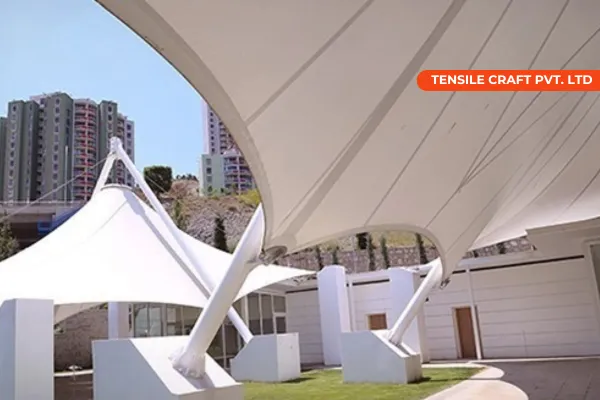
PTFE vs PVC Fabric Guide
Detailed chemical and physical comparison of the two primary membranes.
Fabrics
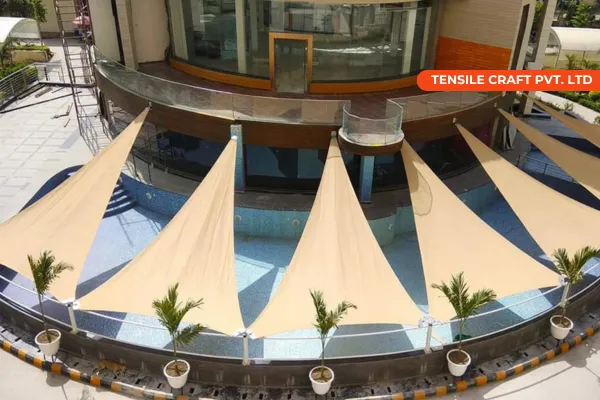
Architecture Design Trends
How ETFE and TiO2 membranes are shaping the future of architecture.
Architecture